Books & Words to Inspire

Blog

Understanding Scripture in Light of a Jewish Timeline

Posts in Tabernacle
Some Differences Between Tabernacle, Temple, and Synagogue

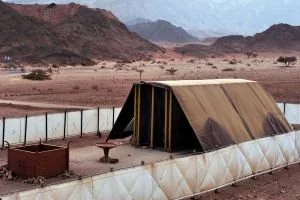
The tabernacle is first mentioned in Exodus 25 when God instructed Moses to build one – also referred to as a tent of meeting – to host the presence of the Lord. The temple in Jewish life refers to the temple built in Jerusalem that was the central place of worship. And the synagogue, historically and today, has served as a gathering place for prayer, instruction, and community. It continues to be central to Jewish life today, as it was in the time of Jesus.

Tabernacle

The design of the tabernacle came down from heaven (Hb 8:5), as did Jesus himself. It took 9 months to create the tabernacle; Jesus was in Mary’s womb for 9 months. The main person in charge of building the tabernacle furniture was Bezalel of Judah (Ex 31:2); Jesus was of the tribe of Judah. The tabernacle was anointed with holy anointing oil (Ex 30:22-30) before it was put into use; Jesus was anointed with the Holy Spirit before he began his ministry (Jn 1:32). Jesus Christ means Jesus the Anointed One.

The tabernacle had only one door; Jesus stated he was the door and the only way to the Father (Jn 10:7). The tabernacle door was made of blue, scarlet, purple, and linen (white); the blue and scarlet represent the water and blood he shed on the cross; purple represents royalty as the robe he had at time of crucifixion; white linen represents the burial cloth in which he was buried.

The Bronze Altar represents judgment and required sacrifice; Jesus bore our judgment and became the atoning sacrifice for us (1Jn 2:2). The Menorah represents Christ’s light and his spirit; Jesus stated he was the light of the world (Jn 8:12). The Table of Shewbread represents Christ body broken for us; Jesus stated he was the bread of life (Jn 6:35). The Altar of incense represents intercessory prayers Christ offers for us as our High Priest (Hb 7:25). The Veil represents Christ’s body and it being ripped from top to bottom is allegory for Christ dying for us by his own volition; Jesus stated the way to the Father is only through him (Jn 14:6). Its colors are the same as those of the door. The Ark of the Covenant represents God’s Throne Room and its Mercy Seat represents God seeing us through the blood of Jesus Christ and declaring us righteous (Ro 3:25, 5:1).

The tabernacle was in use for almost 500 years and represents our pathway to God. Jesus is the door. We immediately face judgment (bronze altar) but Christ becomes the atonement (propitiation) sacrifice for our sin. Yet, we still have our sin nature and require continual cleansing (bronze laver) by God’s word and his holy spirit. We then have fellowship with Christ where he is the light for our path as we walk with him, where he is our sustainer as we partake of him and become more like him, where he is our High Priest and makes intercession for us with the Father. We can come boldly to our Father because of Christ’s crucifixion for us and find the Father declaring us righteous because Christ’s blood covers our sins.

Solomon’s Temple

Solomon’s Temple was the first temple built to replace the tabernacle by King Solomon. His father David had gathered all necessary materials for its construction (1Ch 28:11-19). David also devised how the priests would lead the people in worship. Its building construction started in the fourth year of Solomon’s reign (2Ch 3:2), and it was completed in the eleventh year of his reign (1Ki 6:38): 7 years. Its front faced East.

On the outside of the temple stood the Sea, set upon 12 oxen for the purpose of the priests to wash. This vessel replaced the original laver used in the tabernacle. He also made ten other lavers for the priests to wash the portions of the animals used for sacrifice.

The altar was as wide as the tabernacle itself (20 cubits; 30 feet) and was square. I think it was designed knowing that the population would grow and its surface would be needed for the future number of sacrifices that it would support. At the temple dedication, Solomon offered 22,000 cattle as well as 120,000 sheep and goats. He created additional, temporary altars to offer the burnt offerings, grain offerings, and the fat of the fellowship offerings.

The doors to enter the court were made of bronze. Inside the temple in the Holy Place stood ten menorahs and ten tables for the shewbread: 5 on the north side of the temple and 5 on south side. Palms, chain designs, and cherubim were engraved into the sides of the Holy Place and all were overlaid with gold. He also adorned these with precious stones. The holy place was 60 cubits long (90 feet), 20 cubits wide (30 feet), and 30 cubits high (45 feet).

The doors to the temple were overlaid with gold. A curtain (blue, purple, crimson, and fine linen with cherubim designed into it) was between the Holy Place and Holy of Holies. The Holy of Holies was 20 cubits (30 feet) square. Therefore, stairs were needed from the Holy Place to the Holy of Holies. Its surface was overlaid with gold. He created two large cherubim: each with a wingspan of 10 cubits (15 feet) with each wing 5 cubits (7.5 feet). Therefore, both covered the entire space with their wings outstretched.

The ark would have been turned 90⁰ as the poles would face the door (2Ch 5:9), and they actually protruded into the curtain. There was also a curtain of blue, purple and crimson yarn and fine linen, with cherubim worked into it (2Ch 3:14).

We find the description of cherubim in Ezekiel chapter 1. Their faces looked like this: each of the four had the face of a human being, on the right side each had the face of a lion, and on the left the face of an ox; each also had the face of an eagle. Their feet were like those of a calf and gleamed like burnished bronze. Under their wings on their four sides, they had human hands. They had two wings spreading out upward, one on either side, and two covering its body. Each face represented each aspect of the kingdoms of the Earth God created: humanity (man), livestock (ox), wild animals (lion), and birds of the sky (eagle). Note: fish are always treated as less than for some reason and seem to always be a source of food.

Zerubbabel’s Temple

Zerubbabel’s Temple was built when many of the Israelites returned from Babylonian captivity. Many gave gold, silver, and garments to the construction of a new temple. King Cyrus, back in Babylon, gave back many of the articles of furniture Nebuchadnezzar had taken. The altar was the first thing erected, and in the 7th month, feasts were celebrated and their offerings given. Construction of the temple started in the second month of the second year of their return.

The construction of this temple had several interruptions but was finally completed in the sixth year of the reign of King Darius in the month Adar and the temple dedicated. So that was almost 20 years for it to be completed. Passover, occurring the next month after the temple’s construction, was the first feast celebrated in this newly built temple. We don’t know much about this temple, but we do know it was not as glorious as Solomon’s temple (Er 3:12-13).

Herod’s Temple

Herod’s temple is still called the 2nd temple because the temple functioned without ever stopping rituals during all the building and upgrades that Herod made to Zerubbabel’s temple. Because services never ceased, it is still called the 2nd temple.

The temple was built in Jerusalem where God placed His Name for the place of worship of God. It was used for a variety of communal needs: schools, communal meals, hostels, courts, collection and distribution of charity, political meetings, worship and reading/interpreting the Torah and Prophets.

Herod started improvements to Zerubbabel’s temple in 20 BCE, and it took 46 years to complete: 25 CE. So, it was basically a new building at the start of Jesus’ ministry and was in the process of being built when he was presented as a baby and also when he went for a visit as a twelve-year-old.

The leading scribes at first opposed Herod’s plan as they were very suspicious of the whole thing. They actually believed that once Herod pulled the old building down, he would never replace it. Herod had to promise that he would not touch the old building until he had built the new one around it. Once things commenced, under no circumstances were the services to be interrupted. Herod hired workmen by the thousands. Among them were many priests to build those portions not accessible to ordinary Jews. The work was started by leveling larger portions of the Temple Mount, so that the new building might be erected on a broader base. It was also made much taller, so that the white stone gleamed in the bright Palestinian sun and could be seen from miles away. It was destroyed by the Romans in 70 CE.

Tribulation Temple

The picture of the Tribulation Temple is blurry because we have no idea what this temple will look like. We can assume it will be similar to Herod’s temple, but we don’t know that for sure.

The Bible clearly teaches that a new temple — which will be called The Third Temple — will be built in the future. It will most likely be erected at the beginning of the Tribulation in the form of a tent temple, like the Tabernacle of Moses. A more permanent structure will then be built around and above it. The Antichrist will desecrate this temple in the middle of the Tribulation.

Most Jews in Israel are not interested in building a new temple as they are quite secular and agnostic. Only some of the more orthodox Jews are preparing for the ability to put a new temple in Jerusalem and have been preparing for many years to build all the necessary pieces of furniture required.

There is some controversy around where the temple actually stood within Jerusalem. Many state the current temple mount is exactly where the temple stood. Others say that the temple would need to be south of the current temple mount because the size of the current temple mount is more like the size of the Antonia Fortress. They based this upon the description that the historian Josephus provided.

Josephus effuses about the splendor of the Antonia Fortress and how much Herod, a prolific builder, dispensed for its construction. Herod dubbed the Roman camp “Fort Antonia” after his friend, Mark Antony, and it assured his reputation as a master builder by its unparalleled magnificence. It must have been about 40 acres in size, like other typical Roman camps capable of housing a legion of 5,000-6,000 soldiers. Josephus described it as being “erected upon a rock of fifty cubits in height” on a “great precipice.” It had “all kinds of rooms and other conveniences, such as courts, and places for bathing, and broad spaces for camps, such that it had all the conveniences of cities and seemed like it was composed of several cities.” With 60-foot walls, four towers (the southeast being 105 feet high), and smooth stones installed on its slopes, it dominated the temple to its south, ready to fend off the most formidable attacks.  When any trouble brewed in the temple, or to keep peace during the festivals, Roman soldiers poured out of Fort Antonia onto two 600-foot aerial bridges, connecting it to the roofs of the temple porticoes, whereupon they dispersed around its four-furlong perimeter. If need be, the soldiers could rain their arrows down upon the people in the outer courts or descend via staircases to perform hand-to-hand combat.

Millennial Temple

Ezekiel goes into great detail about how the Millennial Temple during the reign of Christ will look (Ek 44-48). Yet there is still room for interpretation about certain aspects. We can’t say for sure how it will look, but we can know it will be spectacular and may even surpass how marvelous all the previous temples looked.

The Tabernacle existed for 500 years. Solomon’s Temple lasted for 350 years. Zerubbabel’s Temple lasted 497 years. Herod’s Temple lasted for 89 years. The Tribulation Temple will exist for only 3.5 to 7 years while the Millennial Temple will last for 1000 years.

The size of each temple (or tabernacle) plus its court was approximately the size of the next temple itself. Why would this be? As each temple was erected, it had to accommodate more and more people. Therefore, the size of the temple altar kept getting larger to accommodate the number of sacrifices that would be required. Also, the court kept getting larger to accommodate the more people as well as the number of Gentiles that were supposed to be welcomed into Judaism.

For us to understand their size, let’s use the size of an American football field (100 yds long and a little over 50 yds wide). The tabernacle was about one-fourth that size. Solomon’s temple was about three-fourths that size. Herod’s temple was a little over 3 times that size. The Millennial Temple will be over 12 times that size.

Synagogue

The Greek word for synagogue means a gathering of something (in this case, people). It became known as a place of assembly. The synagogue was a reflection of the temple and was used for a variety of communal needs: schools, communal meals, hostels, courts, collect and distribute charity, political meetings, worship and reading / interpreting the Torah and Prophets,

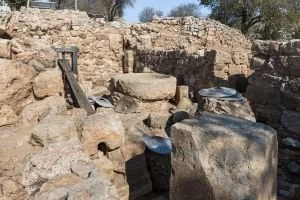
The first synagogue was likely first started during Babylonian captivity with congregations without a building. In Psalms, we read, By the rivers of Babylon we sat and wept when we remembered Zion (Ps 137:1). Some scholars believe the first synagogue building occurred in the 6th century BCE, but the first archeological evidence of a synagogue building is from 3rd century BCE in Egypt as well as in Capernaum. Literature of the 1st century CE refers to numerous synagogues not only in Palestine but also in Rome, Greece, Egypt, Babylonia, and Asia Minor. Several synagogues have been archeologically discovered:

Gamla was an ancient Jewish city on the Golan Heights with a synagogue. During the Jewish-Roman War (66-73 CE), it became a significant stronghold for many Jews. Many committed suicide by jumping to their deaths rather than being captured by the Romans.

Masada was a fortress built by Herod the Great on a plateau on the edge of the Judean desert overlooking the Dead Sea between 37-31 BCE and also contained a synagogue. Herod also had a multi-tiered palace there. It became a stronghold after the Jewish-Roman War (73-74 CE) where zealot rebels took refuge. Romans built a ramp on one side to eventually invade the city. Many of the Jews committed suicide rather than surrender to the Romans.

Herodium was built by Herod the Great as a Fortress and palace about 12 kilometers (7.5 miles) from Jerusalem and 5 kilometers (3 miles) from Bethlehem built between 23 and 15 BCE. The palace itself consisted of four towers of seven stories, a bathhouse, courtyards, a Roman theatre, banquet rooms, a large walkway ("the course"), as well as extravagant living quarters for himself and guests. Once Herod died and the Great Revolt started, Herodium was abandoned. The Jews eventually had a base at Herodium where they built a synagogue which can still be seen today, unlike much of Herod's Palace.

Capernaum was a base camp, so to speak, for Jesus and his disciples. The synagogue remains that are now visible are from the 3rd century.

Synagogues can be built anywhere; a new temple must be built where the previous temple was located. Synagogues do not perform sacrifices. As a way of putting the Temple memory in a special place, they do not use music during prayer. It is a place for prayer, instruction, and community, both in Israel and wherever Jewish people reside.

God has always prepared a way for people to worship and praise him. Praise of him was to be a testimony to his goodness to the world. We are to do the same.

____________

Visit Books & Words to Inspire by Randy C. Dockens

Deeper Meaning of the Tabernacle: Garments

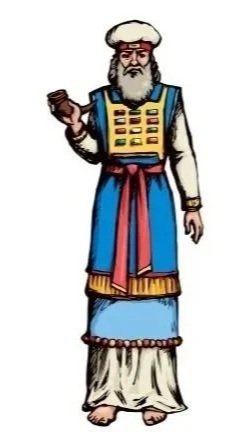
The garments of the priests who served in ministry of the tabernacle were of fine white linen. This represented holiness, purity, and righteousness—traits that were necessary in serving in the presence of a holy God. They wore linen trousers, going from waist to thighs, to ensure their nakedness was covered, a tunic over this that went to their ankles, and a turban on their heads, but cone shaped. The only color worn was the sash that went around their waists composed of the same material as that of the veil of the temple: blue, purple, and scarlet yarn, and white twisted linen. This represented for whom they served in purity and holiness.

The high priest had even more elaborate vestments. Over the white tunic was one of blue color with pomegranates of blue, purple, and scarlet yarn and finely twisted linen around its hem. Golden bells were placed between each pomegranate. Some say the bells helped the other priests to know the high priest was well when in the Holy of Holies as they feared a potential fatal incident similar to that of Nadab and Abihu where God struck them dead due their impropriety of offering unsanctioned fire in their censors (Lv 10:1-3).

Over the blue tunic was the ephod made of threads of pure gold, of blue, purple, and scarlet yarn, and of finely twisted linen. It was made of two pieces (front and back) which were attached at the shoulders with two onyx stones with the names of the tribes of Israel (six on each stone in birthright order) engraved into them and set into a gold setting. This represented the high priest’s responsibility of bearing all of Israel on his shoulders before the LORD. A waistband made of the same material as the ephod was placed around his waist.

On top of the ephod was placed a breastplate made of the same material as the ephod. Onto this was mounted twelve precious stones in four rows of three and placed in golden settings. The name of a tribe of Israel was engraved onto each stone. It is thought that the color of each precious stone reflected the color of the flag (banner or standard) that each tribe possessed (Nu 1:52). The Temple Institute believes the stones and their colors were as follows (Tabernacle):

First row of stones: agate for the tribe of Levi (color: red, white, and black stripes); jade for the tribe of Simeon (color: green); ruby for the tribe of Reuben (color: red);

Second row of stones: quartz for the tribe of Zebulon (color: clear); lapis-lazuli for the tribe of Issachar (color: blue); carbuncle for the tribe of Judah (color: bluish green);

Third Row: agate for the tribe of Gad (color: grey); amethyst for the tribe of Naphtali (color: purple); turquoise for the tribe of Dan (color: blue);

Fourth Row: opal for the tribe of Benjamin (color: all colors); onyx for the tribe of Joseph (color: black); aquamarine for the tribe of Asher (color: blue green).

This breastplate was attached to the ephod with gold chains at its corner and tied to the seam of the ephod just above the waistband to keep it from swinging out from the ephod. This formed a type of pouch in which the Urim and Thummim were kept. It is unclear what these were but are thought to be two stones (one white, one black) to indicate a yes/no answer to questions that the high priest would bring before the LORD.

The high priest wore a turban like those of the other priests but also had a band of pure gold around it, attached with a blue cord, with the words Holy to the Lord engraved on it.

When dedicated to service, Moses placed blood on the lobes of their right ears, on their right thumbs, and on their right big toes (Ex 29:19-21). This was indicative of them dedicating their service to the LORD: hearing and obeying God’s laws, their actions being according to the law as directed by God, and them walking in the ways of the law as God ordained.

The vestments for the high priest were different and more elaborate than that of the other priests for several reasons. One, they show his role as being different, and more strategic, than that of the other priests. It revealed to everyone that he was the mediator between the people and their holy God and the precious stones showed that he bore their needs and their very lives before him and represented them to God and that they, too, were precious to God. The blue robe revealed his role was a heavenly one even though he was on the earth. The pomegranates represented prosperity which he wore before the Lord as his actions were for the betterment of the people he served. The bells, as previously stated, was so the other priests could hear him in the Holy of Holies and know that all was well as they could not enter this part of the tabernacle themselves. All this also pointed to the coming of their Messiah who would become the ultimate mediator between them and God and is the role that Jesus Christ serves for us today (Hb 4:15-16; 9:11-12).

As we can see, every aspect of tabernacle worship pointed to their future hope of their coming Messiah (Jn 1:14) who would be their savior and the one to bring them back to their fellowship with God himself. Today, we can look back at how these elements pointed to Jesus Christ and his death, burial, and resurrection. He had taken our sins (1Pt 2:24) and has enabled a way for us to be right with God again and will allow us to one day be in his presence forever (Jn 14:3). Now isn’t that worth a hearty, Amen!?

Deeper Meaning of the Tabernacle: Furniture

We have looked at the meaning behind the precious metals and fabrics used for the tabernacle. Today, let’s look at each piece of furniture.

There are seven pieces of furniture built for the tabernacle. Five of them were made from acacia wood and then overlaid with either gold or bronze. Acacia was one of the few trees available to the Israelites in the wilderness. It was also very durable and resistant to decay, so it was really an ideal type of wood for such a purpose.

Two pieces were within the courtyard: the bronze altar and the bronze laver. The altar was built of acacia wood, overlaid with bronze, and used for various sacrifices. The laver was constructed of pure bronze and used by the priests for washing their hands and feet before they entered the tabernacle. Both were made from bronze because these pieces symbolized judgment. Sacrifices were made for atonement and the laver for purification. Failure to follow these steps before approaching the tabernacle where God dwelt could lead to drastic consequences. This is evident by two of Aaron’s sons, Nadab and Abihu, who were priests but did not follow proper protocol for the use of censors in their duties and God struck them dead by a consuming fire which came out from the presence of the LORD for their inappropriate actions (Lv 10:1-3).

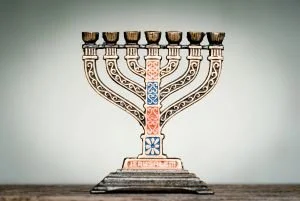
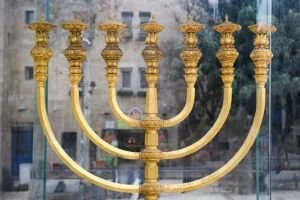
Within the Holy Place of the tabernacle were three pieces of furniture: the Menorah (or lampstand) on the south side, the Table of Shewbread (or Bread of Presence) on the north side, and the Altar of Incense on the west side next to the veil of the tabernacle. The table and altar, made of acacia wood, were overlaid with gold. The menorah was made of one talent (75-100 lbs.) of pure gold and was composed of seven lights (one in the center, and three on either side from branches extending from the central branch). The Table of Shewbread contained twelve loaves of unleavened bread, one for each tribe of Israel. The Altar of Incense represented the prayers of the people. The incense was burned on coals brought in from the bronze altar where the sacrifices were burned.

Past the veil was the Holy of Holies. In this place stood the Ark of the Covenant and the Mercy Seat (or atonement cover). The Ark was made of acacia wood and overlaid with gold. The Mercy Seat was composed of pure gold and sat on top of the Ark of the Covenant. On either end of the Mercy Seat were golden cherubim with outstretched wings spread upward overshadowing the cover. Between these cherubim was where God met with the high priest on each yearly Day of Atonement when the high priest brought blood from the atonement sacrifice and sprinkled it onto the Mercy Seat. Within the ark were kept three things: the ten commandments, a jar of manna, and Aaron’s rod which budded signifying him as God’s chosen for ministering as high priest for the Israeli people.

Each piece of furniture was a representative of a character of Christ. In addition, the position of each piece formed the shape of a cross. The bronze altar represents Christ providing the atonement for our sins (1Jn 2:2), The laver represents the cleansing provided by the Holy Spirit who gives us life (Jn 6:63) and renews us (2Co 5:17) because of Christ’s redemptive work on the cross (Jn 19:30). The menorah represents Christ as the light of the world who gives us enlightenment for how to live for him (Jn 8:12). The Table of Shewbread (Table of Presence) represents Christ as the bread of life, the one who sustains us spiritually (Jn 6:35). The Altar of Incense represents Christ as our intercessor (Hb 7:25) who is now our advocate (1Jn 2:1) before God the Father. The Ark of the Covenant represents Christ who made a blood covenant with us by the shedding of his blood on the cross (Lk 22:20). He is the embodiment and fulfillment of the Law (Mt 5:17), the true manna who sustains us (Jn 6:32-33), and is the proper high priest who intercedes for us (Ro 8:34) and shows his resurrection power which will one day be extended to us who have accepted him as our Savior (Jn 11:25; 1Co 15:20). He is also the Mercy Seat because he made propitiation (atonement for appeasing God’s wrath) for our sins (1Jn 2:2, 4:10).

Understanding all this helps us to better understand the adage that the Old Testament is the New Testament concealed and the New Testament is the Old Testament revealed. The whole Bible is about Jesus Christ and every page reflects him. When some say the Bible is a cohesive whole and not just a collection of stories, this is what they mean. It all points to him because he is the answer for us humans—both in this life and in the life to come. From eternity to eternity, he is always the same (Hb 13:8).

Can I get a hallelujah?!

____________

Visit Books & Words to Inspire by Randy C. Dockens

Deeper Meaning of the Tabernacle: Fabrics

In the previous post, we talked about the precious metals used in the tabernacle (gold, silver, bronze). This time let’s focus on the fabrics used. The fabrics used were also donated to the tabernacle construction by the Israelites and they were part of the plunder God allowed the Israelites to obtain as they left Egypt. This wasn’t a forced plunder but more of a bribe by the Egyptians to get the Israelites out of their land because of all the plagues and death that had occurred (Ex 12:33-36).

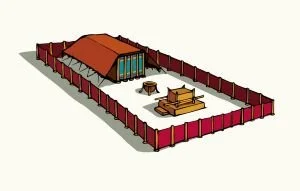
The tabernacle was composed of a courtyard with only one gate to enter and a tabernacle building within it, also with only one entrance. The fabric used for the courtyard fence and the tabernacle coverings were made of fine twined linen. This means this was not ordinary linen but made from fibers that were meticulously twisted together to make the material extremely durable. It would represent the very best type of fabric of their day.

The curtains made from this material for the courtyard fence was white which represented purity and holiness, for the contents of this place was considered holy as this is where God dwelt, or tabernacled, with his people. The courtyard fencing was approximately 150 ft (45 m) long on the north and south sides, and approximately 75 ft (23 m) long on the west and east sides. The curtains were attached to the posts with silver hooks. Each post, 60 total, was atop a bronze base meaning that the tabernacle was based upon judgment. It was a holy place. No one could casually come into this structure.

On the east side, facing sunrise, was the gate to the courtyard. The curtains on this side were composed of blue, purple, scarlet, and white finely twisted linen. These colors represented the heavenly alignment of the tabernacle’s purpose (blue), the divinely appointed aspects of the tabernacle’s contents (purple), the sacrifice/judgment that occurred here (scarlet), and the purity and holiness of the place (white). It is no coincidence that there was only one door. There was only one way to approach God and that was through judgment/sacrifice. Jesus Christ himself reminded his followers of this fact when he stated that he was the door (Jn 10:7-9) and he was the only way to God (Jn 14:6). Almost every aspect of the tabernacle was a foreshadowing of some characteristic of Christ.

The tabernacle itself was composed of four types of coverings. The first covering, visible to only those who entered, was the fine twisted linen which had cherubim embroidered into the fabric as well as the colors blue, purple, and scarlet. Each curtain was made 42 ft (13 m) long and 6 ft (1.8 m) wide. Two sets of five of these curtains were joined together with fifty loops of blue fabric placed on their ends. These two sets were joined together using golden clasps. Over this were placed eleven curtains of goat hair, each slightly larger than the previous curtains. These were 45 ft (13.5 m) long and 6 ft (1.8 m) wide. Again, these were made in two sets: one set of five and one set of six, again with fifty loops on each set but this time were bound together with bronze clasps. The sixth curtain was used as the door of the tabernacle. The additional length of these curtains allowed half of one curtain to form the rear of the tabernacle. This covering provided protection and insulation. Over this covering was placed a covering of ram skins dyed red, and over that a covering of durable leather likely made from a large aquatic mammal (perhaps from porpoise or seal hides as both animals were abundant in the Red Sea).

From the outside, one could only see a drab looking tabernacle, but the inside displayed glorious features but was only seen by the priests who served in the tabernacle. This is reminiscent of how Isaiah portrayed Christ: a man of no special beauty in appearance (Is 53:2), but spiritually he is one of beauty and the one all should seek (Ps 27:4). The goat hair represents that he is our scapegoat and allows us to go free because he is the one sacrificed (Lv 16:7-10) and provides us protection. Thus, the reason for the clasps tying these curtains together being bronze was because bronze represents judgment which was the purpose of the scapegoat symbolizing that Christ would be our sacrifice, our scapegoat, and remove our sins from us (the goat which was set free). The ram skins died red represents his sacrifice for our sins.

There is one other curtain that is important to mention, and that is the veil between the Holy Place of the tabernacle and the Holy of Holies. This curtain was made of blue, purple, and scarlet yarn, and finely twisted linen with cherubim woven into it. It was hung with gold hooks on four posts of acacia wood overlaid with gold and stood on four silver bases. Behind this curtain was the Ark of the Covenant with its Mercy Seat in what was called the Holy of Holies. This curtain separated the area where the priests served within the tabernacle from the area where God himself dwelt within the tabernacle. Only the high priest could go past this curtain and go into this area where God dwelt, and he could only do this once a year to atone for the sins of all Israel.

This curtain represented the way to God and therefore was representative of Jesus Christ as he stated that he was the only way to God (Jn 14:6). A sin sacrifice had to be made before the high priest could go past this curtain. Hence, the reason for the base being silver and not bronze. The high priest could pass once a payment had been made. Jesus Christ’s death on the cross became our payment for our sins.

The whole tabernacle was symbolic of God’s plan to redeem mankind. He did for us what we could not do for ourselves, yet maintaining his holiness and justice. I find it quite remarkable. Don’t you? Join me next time as we look even closer.

____________

Visit Books & Words to Inspire by Randy C. Dockens

Deeper Meaning of the Tabernacle: Precious Metals

When God gave instructions to Moses for him to build the tabernacle, it was not random in how things were to be built and what materials were used. Let’s see if we can understand the meaning behind some of the nuance instructions God gave to Moses about the tabernacle’s construction.

There are three types of metals used in the tabernacle’s construction: gold, silver, and bronze (or brass). To understand this, let’s look at the purpose of each metal used. And before we do that, we need to understand how they had such valuable materials in the first place. Remember, just weeks earlier they had been slaves in Egypt. They were barely getting by. So, how are they now wealthy beyond comprehension? Scripture tells us, but sometimes the answer is presented so matter-of-factly that it doesn’t really register to us how profound such a statement is.

In Exodus we read, “The Israelites did as Moses instructed and asked the Egyptians for articles of silver and gold and for clothing. The LORD had made the Egyptians favorable disposed toward the people, and they gave them what they asked for; so they plundered the Egyptians (Ex 12:35-36).

So, in just a passing, casual statement, Scripture is telling us so much. Did you catch the main word? Plundered. The Israelites plundered the Egyptians. By how much you may ask? We get a glimpse a little later. In Exodus chapter 38, we find the following amounts used in the tabernacle’s construction:

Gold = 29 talents and 730 shekels (v24) = 1,000 kg or 2,200 lbs.

Silver = 100 talents and 1,775 shekels (v28) = 3,430 kg or 7,500 lbs.

Bronze (brass) = 70 talents and 2,400 shekels (v29) = 2,425 kg or 5,300 lbs.

That sounds like a lot for sure. Based upon today’s prices for these metals, this would be worth at least $170 MM! And this was just a fraction of how much the Israelites possessed (Ex 36:6-7). And this doesn’t include all the other precious stones and fabrics that went into the tabernacle. Now, that is what I call plundered.

What was made with each type of precious metal?

Gold: Ark of the Covenant, Mercy Seat, Altar of Incense, Table of Shewbread (Table of Presence), Lampstand (Menorah), clasps to hold tabernacle curtains together, rings to hold the tabernacle crossbars together, hooks to hold the five posts of the gate together, and used to overlay the frames composing the tabernacle, the four posts of the tabernacle, the five posts of the gate, and the tops of the posts and their bands.

Silver: 96 silver bases were used for the tabernacle: 40 placed at the bottom of the frames used for the south side of the tabernacle and repeated for its north side, and 16 for the west side. Each of the 4 tabernacle posts mentioned above had a silver base to it.

Bronze: the altar of sacrifice, and the laver (basin), both of which stood outside the tabernacle itself but within the courtyard, the bases of the poles of the gate to enter the tabernacle, and for all the tent pegs of the tabernacle and the surrounding courtyard.

What do these three metals represent? It is interesting that only bronze is outside the tabernacle and only gold is inside the tabernacle. Silver supported the entire tabernacle.

Understanding that bronze represents judgment, silver represents payment, and gold represents deity and purity gives us a glimpse of what the tabernacle is telling us.

The bases of the posts of the gate to the tabernacle were bronze, meaning one had to pass through judgment to enter. The sacrifice was on a bronze altar representing a sacrifice of judgment and the laver for washing was of bronze representing the need for cleansing before entering a holy tabernacle. This means one could not approach God as they were. A transformation or substitution was required. A person would bring their sacrifice through the gate of judgment, ceremonially pass their sins to the animal which was sacrificed for them. The blood was sprinkled on the altar and poured at its base to represent the atonement being made on behalf of the person. This represents what Christ did for us as he became the ultimate sacrifice required to restore our relationship with God (Hb 10:10).

The entire tabernacle was supported on bases made of silver. The temple shekel was also made of silver. Silver was used for payment. As the adage goes, “nothing is for free.” And that is true here as well. Approaching God and having a relationship with him required a payment, a sacrifice. The Israelites had to repeat this sacrifice repeatedly, but when Christ came, he became the payment required once and for all (1Pt 3:18).

Bronze represented judgment, but once that had been taken care of, the priest could then enter the Holy Place because of the payment made. Christ used the symbolism of the snake, lifted up on a pole by Moses to heal people of their snake bites that had been brought on them for judgment for their actions, to represent himself (Nu 21:8; Jn 3:14-15). Sin places a judgment upon a person and separates them from God. Payment (one’s life) is required to settle that judgment debt (Ro 6:23). The sacrifice placed on the bronze altar was a replacement for that individual. Christ became that sacrifice on our behalf that God required.

The inside of the tabernacle was holy, so all was made of gold. The walls of the tabernacle and all the furniture were of gold. Each piece represented an aspect of Jesus Christ and who he is and what he would become and perform. The lampstand or menorah showed him to be the light of the world (Jn 8:12) to lead us to him, the table of shewbread showed him to be the bread of life (Jn 6:35) who would sustain us and provide to us eternal life, the altar of incense represents him as our high priest (Hb 4:14-15) who makes intercession for us to God on our behalf. He is the mercy seat upon which his blood is placed and covers our sin (Ro 3:15) so God the Father only sees the blood of his Son, Jesus Christ, rather than our sin. And he is the Ark of the Covenant whereby his blood has sealed a blood covenant with us (Mt 26:28) so that by receiving him his blood saves us from eternal death and allows us to have eternal life with him forever. Not because of anything we have done but because of what he did for us. We are declared righteous because of his payment for us (2Co 5:21).

The tabernacle was a representative, or model, of what is in heaven (Hb 8:5). Its plan was given by God to Moses. Although it was a costly building, the resources for its construction were provided by God himself but he used people with no means of their own to produce something they never could have ever dreamed of without God’s help. And isn’t that what he does for us today. He takes our lives, which are worthless on their own, and gives us what is needed to make something wonderful of our lives so they can be devoted to him because without Him, we would forever be nothing. But he has made us new creatures (2Co 5:17) that he can work his will through us.

May He be forever praised.

____________

Visit Books & Words to Inspire by Randy C. Dockens