Books & Words to Inspire

Blog

Understanding Scripture in Light of a Jewish Timeline

Posts in Temple
Some Differences Between Tabernacle, Temple, and Synagogue

The tabernacle is first mentioned in Exodus 25 when God instructed Moses to build one – also referred to as a tent of meeting – to host the presence of the Lord. The temple in Jewish life refers to the temple built in Jerusalem that was the central place of worship. And the synagogue, historically and today, has served as a gathering place for prayer, instruction, and community. It continues to be central to Jewish life today, as it was in the time of Jesus.

Tabernacle

The design of the tabernacle came down from heaven (Hb 8:5), as did Jesus himself. It took 9 months to create the tabernacle; Jesus was in Mary’s womb for 9 months. The main person in charge of building the tabernacle furniture was Bezalel of Judah (Ex 31:2); Jesus was of the tribe of Judah. The tabernacle was anointed with holy anointing oil (Ex 30:22-30) before it was put into use; Jesus was anointed with the Holy Spirit before he began his ministry (Jn 1:32). Jesus Christ means Jesus the Anointed One.

The tabernacle had only one door; Jesus stated he was the door and the only way to the Father (Jn 10:7). The tabernacle door was made of blue, scarlet, purple, and linen (white); the blue and scarlet represent the water and blood he shed on the cross; purple represents royalty as the robe he had at time of crucifixion; white linen represents the burial cloth in which he was buried.

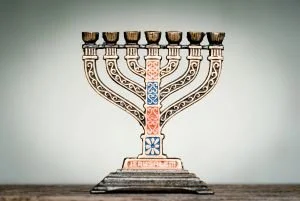
The Bronze Altar represents judgment and required sacrifice; Jesus bore our judgment and became the atoning sacrifice for us (1Jn 2:2). The Menorah represents Christ’s light and his spirit; Jesus stated he was the light of the world (Jn 8:12). The Table of Shewbread represents Christ body broken for us; Jesus stated he was the bread of life (Jn 6:35). The Altar of incense represents intercessory prayers Christ offers for us as our High Priest (Hb 7:25). The Veil represents Christ’s body and it being ripped from top to bottom is allegory for Christ dying for us by his own volition; Jesus stated the way to the Father is only through him (Jn 14:6). Its colors are the same as those of the door. The Ark of the Covenant represents God’s Throne Room and its Mercy Seat represents God seeing us through the blood of Jesus Christ and declaring us righteous (Ro 3:25, 5:1).

The tabernacle was in use for almost 500 years and represents our pathway to God. Jesus is the door. We immediately face judgment (bronze altar) but Christ becomes the atonement (propitiation) sacrifice for our sin. Yet, we still have our sin nature and require continual cleansing (bronze laver) by God’s word and his holy spirit. We then have fellowship with Christ where he is the light for our path as we walk with him, where he is our sustainer as we partake of him and become more like him, where he is our High Priest and makes intercession for us with the Father. We can come boldly to our Father because of Christ’s crucifixion for us and find the Father declaring us righteous because Christ’s blood covers our sins.

Solomon’s Temple

Solomon’s Temple was the first temple built to replace the tabernacle by King Solomon. His father David had gathered all necessary materials for its construction (1Ch 28:11-19). David also devised how the priests would lead the people in worship. Its building construction started in the fourth year of Solomon’s reign (2Ch 3:2), and it was completed in the eleventh year of his reign (1Ki 6:38): 7 years. Its front faced East.

On the outside of the temple stood the Sea, set upon 12 oxen for the purpose of the priests to wash. This vessel replaced the original laver used in the tabernacle. He also made ten other lavers for the priests to wash the portions of the animals used for sacrifice.

The altar was as wide as the tabernacle itself (20 cubits; 30 feet) and was square. I think it was designed knowing that the population would grow and its surface would be needed for the future number of sacrifices that it would support. At the temple dedication, Solomon offered 22,000 cattle as well as 120,000 sheep and goats. He created additional, temporary altars to offer the burnt offerings, grain offerings, and the fat of the fellowship offerings.

The doors to enter the court were made of bronze. Inside the temple in the Holy Place stood ten menorahs and ten tables for the shewbread: 5 on the north side of the temple and 5 on south side. Palms, chain designs, and cherubim were engraved into the sides of the Holy Place and all were overlaid with gold. He also adorned these with precious stones. The holy place was 60 cubits long (90 feet), 20 cubits wide (30 feet), and 30 cubits high (45 feet).

The doors to the temple were overlaid with gold. A curtain (blue, purple, crimson, and fine linen with cherubim designed into it) was between the Holy Place and Holy of Holies. The Holy of Holies was 20 cubits (30 feet) square. Therefore, stairs were needed from the Holy Place to the Holy of Holies. Its surface was overlaid with gold. He created two large cherubim: each with a wingspan of 10 cubits (15 feet) with each wing 5 cubits (7.5 feet). Therefore, both covered the entire space with their wings outstretched.

The ark would have been turned 90⁰ as the poles would face the door (2Ch 5:9), and they actually protruded into the curtain. There was also a curtain of blue, purple and crimson yarn and fine linen, with cherubim worked into it (2Ch 3:14).

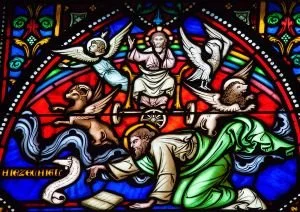
We find the description of cherubim in Ezekiel chapter 1. Their faces looked like this: each of the four had the face of a human being, on the right side each had the face of a lion, and on the left the face of an ox; each also had the face of an eagle. Their feet were like those of a calf and gleamed like burnished bronze. Under their wings on their four sides, they had human hands. They had two wings spreading out upward, one on either side, and two covering its body. Each face represented each aspect of the kingdoms of the Earth God created: humanity (man), livestock (ox), wild animals (lion), and birds of the sky (eagle). Note: fish are always treated as less than for some reason and seem to always be a source of food.

Zerubbabel’s Temple

Zerubbabel’s Temple was built when many of the Israelites returned from Babylonian captivity. Many gave gold, silver, and garments to the construction of a new temple. King Cyrus, back in Babylon, gave back many of the articles of furniture Nebuchadnezzar had taken. The altar was the first thing erected, and in the 7th month, feasts were celebrated and their offerings given. Construction of the temple started in the second month of the second year of their return.

The construction of this temple had several interruptions but was finally completed in the sixth year of the reign of King Darius in the month Adar and the temple dedicated. So that was almost 20 years for it to be completed. Passover, occurring the next month after the temple’s construction, was the first feast celebrated in this newly built temple. We don’t know much about this temple, but we do know it was not as glorious as Solomon’s temple (Er 3:12-13).

Herod’s Temple

Herod’s temple is still called the 2nd temple because the temple functioned without ever stopping rituals during all the building and upgrades that Herod made to Zerubbabel’s temple. Because services never ceased, it is still called the 2nd temple.

The temple was built in Jerusalem where God placed His Name for the place of worship of God. It was used for a variety of communal needs: schools, communal meals, hostels, courts, collection and distribution of charity, political meetings, worship and reading/interpreting the Torah and Prophets.

Herod started improvements to Zerubbabel’s temple in 20 BCE, and it took 46 years to complete: 25 CE. So, it was basically a new building at the start of Jesus’ ministry and was in the process of being built when he was presented as a baby and also when he went for a visit as a twelve-year-old.

The leading scribes at first opposed Herod’s plan as they were very suspicious of the whole thing. They actually believed that once Herod pulled the old building down, he would never replace it. Herod had to promise that he would not touch the old building until he had built the new one around it. Once things commenced, under no circumstances were the services to be interrupted. Herod hired workmen by the thousands. Among them were many priests to build those portions not accessible to ordinary Jews. The work was started by leveling larger portions of the Temple Mount, so that the new building might be erected on a broader base. It was also made much taller, so that the white stone gleamed in the bright Palestinian sun and could be seen from miles away. It was destroyed by the Romans in 70 CE.

Tribulation Temple

The picture of the Tribulation Temple is blurry because we have no idea what this temple will look like. We can assume it will be similar to Herod’s temple, but we don’t know that for sure.

The Bible clearly teaches that a new temple — which will be called The Third Temple — will be built in the future. It will most likely be erected at the beginning of the Tribulation in the form of a tent temple, like the Tabernacle of Moses. A more permanent structure will then be built around and above it. The Antichrist will desecrate this temple in the middle of the Tribulation.

Most Jews in Israel are not interested in building a new temple as they are quite secular and agnostic. Only some of the more orthodox Jews are preparing for the ability to put a new temple in Jerusalem and have been preparing for many years to build all the necessary pieces of furniture required.

There is some controversy around where the temple actually stood within Jerusalem. Many state the current temple mount is exactly where the temple stood. Others say that the temple would need to be south of the current temple mount because the size of the current temple mount is more like the size of the Antonia Fortress. They based this upon the description that the historian Josephus provided.

Josephus effuses about the splendor of the Antonia Fortress and how much Herod, a prolific builder, dispensed for its construction. Herod dubbed the Roman camp “Fort Antonia” after his friend, Mark Antony, and it assured his reputation as a master builder by its unparalleled magnificence. It must have been about 40 acres in size, like other typical Roman camps capable of housing a legion of 5,000-6,000 soldiers. Josephus described it as being “erected upon a rock of fifty cubits in height” on a “great precipice.” It had “all kinds of rooms and other conveniences, such as courts, and places for bathing, and broad spaces for camps, such that it had all the conveniences of cities and seemed like it was composed of several cities.” With 60-foot walls, four towers (the southeast being 105 feet high), and smooth stones installed on its slopes, it dominated the temple to its south, ready to fend off the most formidable attacks.  When any trouble brewed in the temple, or to keep peace during the festivals, Roman soldiers poured out of Fort Antonia onto two 600-foot aerial bridges, connecting it to the roofs of the temple porticoes, whereupon they dispersed around its four-furlong perimeter. If need be, the soldiers could rain their arrows down upon the people in the outer courts or descend via staircases to perform hand-to-hand combat.

Millennial Temple

Ezekiel goes into great detail about how the Millennial Temple during the reign of Christ will look (Ek 44-48). Yet there is still room for interpretation about certain aspects. We can’t say for sure how it will look, but we can know it will be spectacular and may even surpass how marvelous all the previous temples looked.

The Tabernacle existed for 500 years. Solomon’s Temple lasted for 350 years. Zerubbabel’s Temple lasted 497 years. Herod’s Temple lasted for 89 years. The Tribulation Temple will exist for only 3.5 to 7 years while the Millennial Temple will last for 1000 years.

The size of each temple (or tabernacle) plus its court was approximately the size of the next temple itself. Why would this be? As each temple was erected, it had to accommodate more and more people. Therefore, the size of the temple altar kept getting larger to accommodate the number of sacrifices that would be required. Also, the court kept getting larger to accommodate the more people as well as the number of Gentiles that were supposed to be welcomed into Judaism.

For us to understand their size, let’s use the size of an American football field (100 yds long and a little over 50 yds wide). The tabernacle was about one-fourth that size. Solomon’s temple was about three-fourths that size. Herod’s temple was a little over 3 times that size. The Millennial Temple will be over 12 times that size.

Synagogue

The Greek word for synagogue means a gathering of something (in this case, people). It became known as a place of assembly. The synagogue was a reflection of the temple and was used for a variety of communal needs: schools, communal meals, hostels, courts, collect and distribute charity, political meetings, worship and reading / interpreting the Torah and Prophets,

The first synagogue was likely first started during Babylonian captivity with congregations without a building. In Psalms, we read, By the rivers of Babylon we sat and wept when we remembered Zion (Ps 137:1). Some scholars believe the first synagogue building occurred in the 6th century BCE, but the first archeological evidence of a synagogue building is from 3rd century BCE in Egypt as well as in Capernaum. Literature of the 1st century CE refers to numerous synagogues not only in Palestine but also in Rome, Greece, Egypt, Babylonia, and Asia Minor. Several synagogues have been archeologically discovered:

Gamla was an ancient Jewish city on the Golan Heights with a synagogue. During the Jewish-Roman War (66-73 CE), it became a significant stronghold for many Jews. Many committed suicide by jumping to their deaths rather than being captured by the Romans.

Masada was a fortress built by Herod the Great on a plateau on the edge of the Judean desert overlooking the Dead Sea between 37-31 BCE and also contained a synagogue. Herod also had a multi-tiered palace there. It became a stronghold after the Jewish-Roman War (73-74 CE) where zealot rebels took refuge. Romans built a ramp on one side to eventually invade the city. Many of the Jews committed suicide rather than surrender to the Romans.

Herodium was built by Herod the Great as a Fortress and palace about 12 kilometers (7.5 miles) from Jerusalem and 5 kilometers (3 miles) from Bethlehem built between 23 and 15 BCE. The palace itself consisted of four towers of seven stories, a bathhouse, courtyards, a Roman theatre, banquet rooms, a large walkway ("the course"), as well as extravagant living quarters for himself and guests. Once Herod died and the Great Revolt started, Herodium was abandoned. The Jews eventually had a base at Herodium where they built a synagogue which can still be seen today, unlike much of Herod's Palace.

Capernaum was a base camp, so to speak, for Jesus and his disciples. The synagogue remains that are now visible are from the 3rd century.

Synagogues can be built anywhere; a new temple must be built where the previous temple was located. Synagogues do not perform sacrifices. As a way of putting the Temple memory in a special place, they do not use music during prayer. It is a place for prayer, instruction, and community, both in Israel and wherever Jewish people reside.

God has always prepared a way for people to worship and praise him. Praise of him was to be a testimony to his goodness to the world. We are to do the same.

____________

Visit Books & Words to Inspire by Randy C. Dockens

Does Your Temple Need Cleansing?

This past Sunday was Palm Sunday or as some refer to it as the day of Christ’s Triumphal Entry. It was a day of fulfilled prophecy (Zc 9:9) and Jesus stated that if the people and the children didn’t praise him at this time, the very rocks would cry out (Lk 19:40; Hk 2:11). So the expectation was set, but what happened? It seemed to all fizzle once Jesus reached the temple on his donkey ride. This is where the real hype should have escalated. The temple was where kings were anointed and proclaimed (2Ki 11:12). Why did the hype all fizzle out? What greeted Jesus at the temple? Bleating of sheep and goats, the mooing of cattle, the chaos of people buying and selling. No one at the temple was looking for a king. The Jewish leaders were nowhere to be seen.

The people who yelled and sang “Hosanna,” were not saying it because of who Jesus was, but because they thought Rome was now going to be defeated. Their oppressors would be vanquished, and they would have peace. The word “hosanna” was a cry meaning, “save us.” Yet, when Jesus entered the temple grounds, he knew they needed a deeper salvation than being freed from Roman oppression. Their temple was not ready to receive him as king. They were not spiritually minded at all! All around him he saw greed and extortion. The people had to exchange their money for the temple shekel and the exchange rates were exorbitant. The merchants here were not here for helping travelers to obtain their sacrifice, but to extort money from them for that sacrifice. And who controlled all of this? The Jewish leaders who were the ultimate ones getting rich off the people’s misery. They, too, were not really interested in helping their citizens worship God, but they saw the people beneath them and a means to make money from them. They were using the Law to justify their extortion of the people. Helping the people experience God in their lives was the farthest thing from their minds.

Also, the outer area was called the Court of Gentiles. This was the only place a non-Jew could worship God. But how could they? There were people, animals, vendor stands, all creating so much noise and chaos that they could not have an encounter with God. It seemed the Jewish leaders wanted Gentile proselytes, not so they could encounter God, but for the sake of extorting them as well. The temple had evolved into a place where God could not be worshipped. No wonder this caused Jesus’ ire against them.

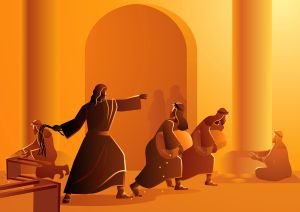
Jesus knew immediately that they were not ready for a king. They definitely needed saving, but not from Rome. Or that was not their immediate need. They needed true salvation: being saved from their sin. Jesus knew he needed to work on their hearts before anything else would or could be meaningful. Therefore, he drove out the merchants, moneychangers, and animals and reprimanded the Jewish leaders for their greed and unrepentant hearts. Did they heed or try to understand what Jesus was doing? No. They asked what authority he had to do what he did (Mk 11:28). That means they had no understanding of who Jesus was and only had animosity for him. They had no repentant heart and dared anyone to question their motives. Even though they knew their motives were not pure, they believed their traditions were more important than the reasons behind why their traditions had been established. They were meeting the “letter of the Law” but not the “spirit of the Law.” Jesus knew that, and that is why he was ultimately arrested and crucified and not crowned king. He knew they first needed redemption, so he willingly submitted himself to that end.

What about us today? Are we really worshipping God or are we going through the motions? Were you excited about celebrating Palm Sunday or were you anxious for the service to be over so you could do what you really wanted to do for the rest of the day? Were you, like the Jewish leaders, going through the motions to appease your conscious trying to convince yourself that you are doing your best? Or are you realizing that you first need to get your heart in line with God so that your actions will be a result of you following God’s will, not a façade to give the appearance you are on God’s side?

Let’s take the time this season to fully understand why Jesus cleansed the temple. And to realize that he wants to do the same for us today. After all, we are now God’s temple (1Co 6:19). Have we polluted it and filled it with things that should not be there? Are we trying to justify what we have filled it with rather than asking  God what he wants us to have there?

Let’s take the time and make our temples holy. It is only then that God can use us in the way he desires. Let’s also make our temple a house of prayer and praise to the One True God. Then, and only then, can Jesus be on the throne of our hearts.

____________

Visit Books & Words to Inspire by Randy C. Dockens

Something New but Familiar

It seems it always helps when you experience something new to also have something familiar with which to reference. This is what Ezekiel experienced. In previous posts we discovered that his thoughts were on the temple since he was in captivity in Babylon. God gave him a vision of a new temple that would be established in the future. While many things were new and different, it had a feeling of familiarity at the same time.

The size of the temple complex is something to consider. If you take a football field and put three end-to-end both in width and length, that would be about the size of it. That’s quite the size, isn’t it? However, the size of the temple itself didn’t change much from that of previous temples. The size of the entire tabernacle could almost fit inside the temple structure of Solomon’s temple, although the entire complex was much larger. Yet, the size of Solomon’s temple was basically equivalent to that of Herod’s temple and of the temple in Ezekiel’s vision. The size of the entire complex of each temple did increase with each successive temple.

The tabernacle, Solomon’s temple, and Herod’s temple had a bronze altar, a laver, a menorah, a table of shewbread, and an altar of incense. Herod’s temple did not have the ark of the covenant and the mercy seat as those were lost in Ezekiel’s day when Nebuchadnezzar destroyed the temple. The temple in Ezekiel’s vision had only the bronze altar and the altar of incense. We discussed this briefly previously. All the other elements had been fulfilled by Christ: the laver represents the word of God which cleanses from sin (Ep 5:26). Christ is the living word of God (Jn 1:1) and is physically present. The menorah represents Christ as the light of the world (Jn 9:5), the table of shewbread represents Christ as the bread of life (Jn 6:35), the ark of the covenant represents Christ’s glory dwelling in the Holy of Holies (Ek 43:7), and the mercy seat represents Christ as the propitiation for sin and is already completed (1Jn 2:2). The bronze altar represents that atonement is still needed for those born, and the altar of incense represents the prayers of thanksgiving by those who have accepted Christ’s atonement for one’s sins and who is the hope of their future.

The bronze altar is arranged in a tier fashion and has steps leading up its eastern side. It is interesting that in Solomon’s temple this was a ramp instead of steps and was located on the southern side of the altar. This altar is quite large, being 10.5 feet high with its top being 21 ft sq. It would seem the priests will have to be quite strong to carry these sacrifices up these steps and get them close to the center of the altar.

It seems that the same sacrifices as previously made will now continue: burnt offerings, peace (fellowship) offerings, sin offerings, trespass (guilt) offerings, grain (meat) offerings. Why is this? Sacrifices are now needed for three basic reasons: (1) because a theocracy is re-established where sin must be dealt with when part of the sinless Trinity is physically present, (2) it seems death no longer occurs as there is no additional resurrection of the righteous dead mentioned in scripture, (3) sacrifices were always symbolic for they never took away sin and faith has always been required. All of these reasons help those born during this time to see their need for accepting Christ their King as their Savior and the Hope for their future.

It also seems that four of the seven feasts typically celebrated each year (Lv 23) will still be celebrated during this time: Pesach (Passover), Matzah (Unleavened Bread), Bikkurim (Firstfruit), and Sukkot (Tabernacles). While these have been fulfilled, these are still needed because these feasts represent the death, burial, and resurrection of Christ, as well as his literal dwelling with his people. The other three are already fulfilled and are not needed: Shavuot (Pentecost) – the giving of the Holy Spirit; Rosh Hashanah (Trumpets) – God remembering his covenant with Israel (Tribulation Period), Yom Kippur (Day of Atonement) – God forgiving Israel of their sins (at Christ’s return).

As you can see, there will be many similar things that have been reshaped and slightly different. What is familiar has been reshaped for the needs of the new age. These things will help those who are already bound to their Messiah, their King, a new way to celebrate and worship him. These things will help those who need to make a decision about their King a way to understand their need to accept him. What is new will also be familiar.

This is going to be an amazing time. I hope you are making plans to not miss it. Something so wonderful should not be missed.

____________

Visit Books & Words to Inspire by Randy C. Dockens

Prelude to Wonderment

Good things usually take work; sort of a prelude to wonderment, if you will. God was showing Ezekiel the finished product when he was taken to the future Jerusalem. In our last post, we looked at some of the physical changes that had to occur before the temple Ezekiel saw was put into place. Today, let’s look at other preparations needed for this temple.

The prophet Daniel gives us one clue to when the preparation for this temple and the Promised Kingdom in which it will be utilized will occur. He seems to state that from the end of what is called The Tribulation Period to the beginning of this Promised Kingdom is a period of 45 days (Dn 12:11-13). There has been much speculation what this is supposed to mean, but it would make sense that there is a need for a time of preparation, or a prelude as I called it earlier. So, what will occur during this 45-day period. A lot actually:

·       The angels will be judged (1Co 6:3; Mt 25:41)

·       The survivors will be judged (Mt 25:31-46)

·       Assignments for the saints will be set in motion (Dn 12:13; Jr 30:9; Mt 19:28)

·       Nations, property, and laws will be established for the next 1000 years (Zc 14:17-21)

·       The temple is built (Ek 43:6-7; Zc 6:12-13).

The first question is whether 45 days is enough time to do all of that? Well, the simple answer is God can do anything. Some may think that a lame answer. Yet, it is true. However, let’s think about this. The number of people assisting are numerous, plus you will have angels helping as well. All these things will likely occur simultaneously. So, yes, I think even with our limited reasoning and understanding, 45 days is enough time to get all these things accomplished.

Who all will be part of the Millennium and experience all these wonderful things? The beginning of the Millennium will be almost like the antithesis of the earth after The Receiving (also called the Rapture). At this time, all those who have not accepted Christ as their Savior are removed. Two groups then enter the Millennium. One group is composed of those who were alive at the time of Christ’s return and who had accepted him as the hope for their future by placing their faith in him. They enter the Millennium in their current human bodies.

The other group is composed of those who are part of what is known as the first resurrection. These enter the Millennium in glorified bodies and will consist of the following: (1) those who returned with Christ when he came to destroy the Antichrist and bind Satan (Rv 19:14); these are considered the church, i.e., those from Christ’s resurrection until The Receiving who put their faith in him; (2) those who put their faith in Christ, their Messiah, prior to his resurrection (Dn 12:1-1); these are resurrected after Christ’s return and before the start of his reign (Rv 20:4); (3) those martyred for their faith during the Tribulation period; these also are resurrected after Christ’s return and before the start of his reign (Rv 20:4).

Can we know for sure that this will be a literal temple and Ezekiel’s vision not just allegory? I think there are at least two reasons we need to consider before we just dismiss this and ignore it.

1.      The detail provided about the temple is so great. It sort of reminds us of the detail God gave to Moses about the tabernacle. We know that was a real structure. Why give such detail if the whole thing is just allegory? Detail seems to imply actuality.

2.      The reason for this vision of the temple implies actuality. Remember, Ezekiel’s thoughts at this time were about the temple in Jerusalem, the sacrifices no longer being performed, and what all of that meant for himself and his people going forward. God is showing Ezekiel the future to give him hope. Hope gives purpose and resolve. Hope must be something tangible. Allegory can never provide hope because it is not tangible. God was giving Ezekiel hope. Therefore, the temple was something tangible.

Now, if this is tangible and real, the next question is why. Why would there need to be a temple with sacrifices? After all, didn’t Christ abolish the need for this? We have covered this previously, but I think it is worth repeating here. The sacrificial system will be a demonstration of what death means and how it creates separation. In one sense it is a visual aid—a very graphic one—and will show the seriousness of the consequence of one’s disobedience. As we stated above, the first resurrection brought those dead, and who had put their faith in Christ their Messiah, back to life. There is no record of another resurrection of the righteous, so death of the righteous is likely abolished during this time. A theocracy is re-established. Since Christ will be physically present, there is a need for cleansing for worship of a holy God. The sacrificial system demonstrates this need for holiness and purity in the presence of someone holy (Ek 43:26; Zc 13:1). This will also fulfil God’s promise to Israel that they as a nation will lead the world in worship of the one true God.

This temple is also different from what the Jews had up until this time. I’m sure this was not lost on Ezekiel who had trained to be a priest, but who never served because of his captivity. Also, certain Jewish feasts are observed, but not all. Passover (Pesach), Unleavened Bread (Matzah), and Firstfruit (Bikkurim) will be held to represent the death, burial, and resurrection of Christ, now their King. The altar for sacrifices in front of the temple is still present to help the people see what their King did for them by taking their sins onto himself and accepting their punishment, i.e., death. They will have a visual representation of this. Passover will also be a celebration, not of God gathering them from Egypt into their Promised Land, but from gathering Jew and Israeli from all countries of the globe back to Israel and into his Promised Kingdom.

Inside the temple there is only the altar of incense, which represents the prayers of the people going up to their King. Coals from the altar of judgment are placed on the altar of incense to represent prayers of thanksgiving to their King for the payment he made in their place. The laver is gone, because their King is the one who purifies and is present with them. The menorah is gone, because their King is the light of the world and is present with them. The table of shewbread is gone, because their King is the bread of life and is present with them. The ark of the covenant and mercy seat are gone because their King now dwells in the Holy of Holies and is physically present with them. Celebrating the feast of tabernacles, or Sukkot, will be a celebration of their Messiah, their King, now physically dwelling with them. So, you see, there are many similarities to what the Jews once had, but also key significant differences. These differences are what is key and the answer to our question of why.

Does this get you excited? I hope it does. It will be a wonderful time—a time more wonderful than any current words can express. Prepare yourself. Put your faith in the one who will be the only one who can accomplish such things for us, the one who will become the King of kings, and still be the hope of our future.

____________

Visit Books & Words to Inspire by Randy C. Dockens

Apocalypse Sets Stage for Wonder

Seen a good movie lately? Don’t they all show how bad something gets before things turn around and become wonderful, setting the stage for good out of the chaos? There was prelude which occurred right before the vision God gave to Ezekiel (Ek 40-48). We see this prelude through the eyes of other prophets. Let’s explore that today.

The vision given to Ezekiel occurred in the twenty-fifth year of his captivity and the fourteenth year since the fall of Jerusalem (Ek 40:1). Therefore, enough time had passed which allowed Ezekiel to really think about his peoples’ future and what was possibly in store for them. God answered his thoughts by giving him a vision of a future temple which will be much different from any previous temple Ezekiel was familiar with. It is also interesting that this occurred in a month that would have had Ezekiel thinking about the temple in Jerusalem. This verse tells us his vision occurred on the tenth day of the first month of the year. This was either the first month of the Jewish calendar which would represent the day the lamb would be set aside for Passover to ensure it was without blemish and acceptable (Ex 12:1-6). Or, it would have been the seventh month of the Jewish calendar (and first month of the Babylonian calendar) and represent the normal Day of Atonement when the high priest would enter the Holy of Holies of the temple to appease for the sins of the people (Lv 16; 23:27). Either of these circumstances would have Ezekiel thinking about the temple.

Yet, when God first brought him to Jerusalem to see the temple, Ezekiel did not recognize where he was (Ek 40:2). He was on a high mountain which was unfamiliar to him. The vision and purpose of this high mountain had been given to Micah and Isaiah, where they state that in the last days the mountain of the Lord’s temple will be established as the highest of the mountains and will be exalted above the hills and all nations will stream to it (Mi 4:1: Is 2:2). Isaiah further stated that every valley would be raised up and every mountain and hill would be made low, the rough ground will become level, and the rugged places made into a plain (Is 40:4). John the Baptist stated that this reference referred to the time of their coming Messiah (Lk 3:5). It is likely this will occur when the Great Earthquake happens as Christ touches down on the Mount of Olives (Zc 14:4-5; Rv 16:18).

There are three tectonic plates surrounding Jerusalem: Arabian plate, Sinai plate, and Gaza plate. In addition, there are three major plates which meet at the Afar Triangle in Somalia: the African plate, the Indian plate, and the Arabian plate. Then, there is a rift which travels from the Afar Triangle, up the Red Sea, through the Sea of Aqaba and up the Jordan basin. Then the Palmyra fold belt extends from the upper Jordan basin to the Euphrates River. The great earthquake which occurs will then release the tension from between all these junctures and create multiple, and huge, land transformations. The Mount of Olives will split in two (Zc 14:4), Jerusalem will split into three parts (Rv 16:19), and likely the Euphrates River will be channeled into the Jordan River making the waters of Dead Sea viable as it receives more fresh water into it and a channel is made for water to exit the Dead Sea into the Sea of Aqaba. In addition, water will flow out from Jerusalem (where the temple will be built) into the Dead Sea and around an escarpment into the Mediterranean Sea (Zc 14:8). This escarpment will form due to the earthquake which will push the area of Jerusalem and westward up and make a plain eastward. This escarpment will be from Geba, about five miles north of Jerusalem, to Rimmon, about thirty-five miles south of Jerusalem.

It is, therefore, understandable why Ezekiel did not recognize this mountain. God was showing him the future when God’s Millennial Kingdom will be formed, and Jerusalem will be situated on the highest mountain on the planet (Zc 14:10; Is 2:2; Mi 4:1). So, our coming Messiah will reign on high, both literally and figuratively. He will reign from the highest point on the planet and be King of kings—sovereign overall. This is going to be a glorious time. Don’t miss it!

____________

Visit Books & Words to Inspire by Randy C. Dockens

Why Ezekiel Called His People Guilty

God tells Ezekiel to prophesy against the mountains of Israel (Ek 6:1). That seems like a strange thing to do, but God had a purpose. The mountains were where all the high places, i.e., the altars to other gods, were placed and worshiped. This practice went all the way back to King Solomon. Despite what the good king Solomon had done and the magnificent temple he had built for the worship of God, he also built these altars to other gods. Why would he do such a thing? Scripture tells us he had 700 wives and 300 concubines (1Ki 11:3). It was the custom in that day for another kingdom to give the daughter of their ruler as a bride to the ruler of another kingdom to seal the bond between their two peoples. Solomon built a huge empire, and he obviously used this custom to his advantage—and did it quite often. Yet, his wives began to complain because they were now in a place with different customs, and they missed their own rituals and customs. Rather than teaching them his ways and customs, and about his God, he let them have their way and he made for them altars to their various gods (1Ki 11:4-9). As you can imagine, the people’s attitude became, “if the king thinks such practices are allowable, then we can do the same.” At first, it was a mixture of worshipping God and these other idols. Yet, over time, the worship of God waned, and the worship of these idols increased. Why? Well, worshipping God had rules about refraining from certain practices. Yet, worshipping these false gods appeased their base instincts. They could let themselves go, have sex with women who were not their wives, have sex with other men, get intoxicated with wine and lust, and let go of all inhibitions. Of course, this led to all sorts of other problems, but the people did not see, or refused to see, the connection of their issues with their rejection of God. By the time of Ezekiel, some 300 years later, the temple was in much disrepair while the high places were still in full swing.

We can see in scripture the slow demise of the temple. Under king Rehoboam, the son of Solomon, Shishak, king of Egypt, attacked Jerusalem and took treasures from the temple back to Egypt (1Ki .14:25). Later, king Asa of Judah took all the remaining silver and gold from the temple’s treasury to Ben-Hadad, king of Aram in Damascus, to bribe him to go to war against Israel (1Ki 15:18). Later, king Ahaz also took silver and gold from the temple’s treasury, and may have taken gold off the temple itself, to bribe the king of Assyria to attack Damascus (2Ki 16:8). He also had a duplicate altar like he saw in Damascus put in place of the bronze altar in Jerusalem and put the bronze altar, originally in front of the temple’s entrance facing east, on the north side of the temple (2Ki 16:10-14). It seems he took the bronze from the lavers Solomon had made and the twelve-oxen base of the giant laver to make this altar (2Ki 16:17). Ahaz even dismantled some of the structures attached to the temple so as not to offend the king of Assyria (2Ki 16:18). He also took the furnishings of the temple and cut them in pieces, shut the temple doors, and set up altars at every street corner in Jerusalem (2Ch 28:24). King Hezekiah took the silver in the temple treasury and stripped gold off the temple doors and doorposts and gave it to the king of Assyria trying to bribe him to withdraw from Jerusalem (2Ki 18:16). As you can see, all the gold was already depleted from the temple’s treasury and so he resorted to more drastic measures to obtain the gold the king of Assyria demanded. Hezekiah’s son, Manasseh, built altars to other gods within the temple courtyard, put Asherah poles (i.e., phallic symbols) within the temple, had an image placed within the temple, and had living quarters constructed within the temple courtyard for the male shrine prostitutes which were now part of their worship rituals (2Ki 21:4-7, 23:7; 2Ch 33:7). So, you can see the temple lost its significance to the people and in the end was used for something totally against God, whereas it was originally built as something beautiful in which the people could worship God.

God stated he was going to put an end to these practices in a severe way. God would have king Nebuchadnezzar destroy all these high places, but it would not end there. Many would die by the sword. Those who did not die by the sword, would die by plague. When there are so many deaths at once, the other people cannot attend to bodies properly, so they breed plagues. Many will flee seeking to save their lives, but God states the plague would follow them. After all, animals and rodents are the ones who carry the plagues, and they are wherever the people are. Many would flee to Jerusalem, as cities had walls for protection, but God states this will not be a protection for them, but a death trap. Those inside Jerusalem would die from starvation because Nebuchadnezzar would surround the city and not let anyone in or out. Food supplies would dwindle, Jerusalem’s economy would collapse (Ek 7:12-13). Even the gold of the wealthy would become useless (Ek 7:19).

While we may chide them for their actions, can we really do that considering our own actions? They neglected their temple and worship of God. Are we not guilty of the same? Today, his temple is our bodies, as that is where the Holy Spirit dwells (1Co 3:16). Are we making it a pure place for him or are we crowding him out with other things. Yes, I think we have a lot to learn from Ezekiel and his message to his people. Let’s heed the message for ourselves as well. We can accomplish so much more with a guilt-free conscience.

____________

Visit Books & Words to Inspire by Randy C. Dockens

Something New but Familiar

It seems it always helps when you experience something new to also have something familiar with which to reference. This is what Ezekiel experienced. In previous posts we discovered that his thoughts were on the temple since he was in captivity in Babylon. God gave him a vision of a new temple that would be established in the future. While many things were new and different, it had a feeling of familiarity at the same time.

The size of the temple complex is something to consider. If you take a football field and put three end-to-end both in width and length, that would be about the size of it. That’s quite the size, isn’t it? However, the size of the temple itself didn’t change much from that of previous temples. The size of the entire tabernacle could almost fit inside the temple structure of Solomon’s temple, although the entire complex was much larger. Yet, the size of Solomon’s temple was basically equivalent to that of Herod’s temple and of the temple in Ezekiel’s vision. The size of the entire complex of each temple did increase with each successive temple.

The tabernacle, Solomon’s temple, and Herod’s temple had a bronze altar, a laver, a menorah, a table of shewbread, and an altar of incense. Herod’s temple did not have the ark of the covenant and the mercy seat as those were lost in Ezekiel’s day when Nebuchadnezzar destroyed the temple. The temple in Ezekiel’s vision had only the bronze altar and the altar of incense. We discussed this briefly previously. All the other elements had been fulfilled by Christ: the laver represents the word of God which cleanses from sin (Ep 5:26). Christ is the living word of God (Jn 1:1) and is physically present. The menorah represents Christ as the light of the world (Jn 9:5), the table of shewbread represents Christ as the bread of life (Jn 6:35), the ark of the covenant represents Christ’s glory dwelling in the Holy of Holies (Ek 43:7), and the mercy seat represents Christ as the propitiation for sin and is already completed (1Jn 2:2). The bronze altar represents that atonement is still needed for those born, and the altar of incense represents the prayers of thanksgiving by those who have accepted Christ’s atonement for one’s sins and who is the hope of their future.

The bronze altar is arranged in a tier fashion and has steps leading up its eastern side. It is interesting that in Solomon’s temple this was a ramp instead of steps and was located on the southern side of the altar. This altar is quite large, being 10.5 feet high with its top being 21 ft sq. It would seem the priests will have to be quite strong to carry these sacrifices up these steps and get them close to the center of the altar.

It seems that the same sacrifices as previously made will now continue: burnt offerings, peace (fellowship) offerings, sin offerings, trespass (guilt) offerings, grain (meat) offerings. Why is this? Sacrifices are now needed for three basic reasons: (1) because a theocracy is re-established where sin must be dealt with when part of the sinless Trinity is physically present, (2) it seems death no longer occurs as there is no additional resurrection of the righteous dead mentioned in scripture, (3) sacrifices were always symbolic for they never took away sin and faith has always been required. All of these reasons help those born during this time to see their need for accepting Christ their King as their Savior and the Hope for their future.

It also seems that four of the seven feasts typically celebrated each year (Lv 23) will still be celebrated during this time: Pesach (Passover), Matzah (Unleavened Bread), Bikkurim (Firstfruit), and Sukkot (Tabernacles). While these have been fulfilled, these are still needed because these feasts represent the death, burial, and resurrection of Christ, as well as his literal dwelling with his people. The other three are already fulfilled and are not needed: Shavuot (Pentecost) – the giving of the Holy Spirit; Rosh Hashanah (Trumpets) – God remembering his covenant with Israel (Tribulation Period), Yom Kippur (Day of Atonement) – God forgiving Israel of their sins (at Christ’s return).

As you can see, there will be many similar things that have been reshaped and slightly different. What is familiar has been reshaped for the needs of the new age. These things will help those who are already bound to their Messiah, their King, a new way to celebrate and worship him. These things will help those who need to make a decision about their King a way to understand their need to accept him. What is new will also be familiar.

This is going to be an amazing time. I hope you are making plans to not miss it. Something so wonderful should not be missed.

____________

Visit Books & Words to Inspire by Randy C. Dockens