Trek of the Tabernacle in the Wilderness
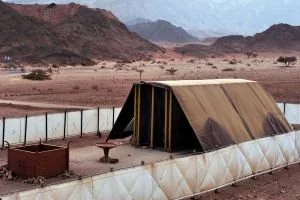
Model of the tabernacle - Timna Park, Israel
The Israelites left Egypt the day after Passover (and the tenth plague: the death of the firstborn). The Egyptians gave them all sorts of gold, silver, precious stones, and garments of various fabrics in order to bribe them to leave. This day would later become known as Feast of Unleavened Bread (or Feast of Matzah).
They traveled down what is today known as the Sinai Peninsula to Succoth and waited while other Israelites were retrieved from the mines which were near there. This is a speculation, but the Bible does say they paused there, and it is known that turquoise mines were nearby at Serabit el-Khadim.
They continued down the peninsula toward its apex, past Midgol, an Egyptian fortress outpost. After going past Midgol, they stopped at Etham which became an impasse due to the mountains. During this time, God was a cloud to them by day and a pillar of fire by night so they could travel both day and night. They arrived at Etham on Day 16.
God had them retreat and go back to the straits of Tiran. Exodus tells us, “Tell the Israelites to turn back and encamp near Pi Hahiroth, between Migdol and the sea. They are to encamp by the sea, directly opposite Baal Ziphon” (Ex 14:1). Pi-Hahiroth means “mouth of canal.” God was telling the Israelites to camp at the mouth of the canal where the Arabian sea splits into the Gulf of Suez and the Sea of Aqaba and to be directly across of Baal Ziphon. Baal Ziphon was on Mt. Tiran on an island across the mouth of the canal which was at the border of the Red Sea and the Gulf of Aqaba. The passage through the Red Sea would be just north of this island.
Going backward in their trek provided a signal to the Egyptians at Midgol that they were struggling to find their way. This was reported to Pharaoh, likely by carrier pigeon. Pharaoh and his troops came quickly to get the Israelites back as Pharaoh realized their slave force was now gone. This would mean the Israelites camped there on the shore for about a week or so until Pharaoh arrived. God then moved between the Israelites and Egyptians while he made a path through the Red Sea. This saved the Israelites but caused the deaths of the Egyptians.
After crossing the Red Sea from the Sinai Peninsula to the Arabian Peninsula, the Israelites were on an emotional high. However, it took three days for them to get to Marah where the waters were too bitter to drink. The Israelites complained. God showed Moses what wood to put into the water and the waters then became drinkable.
They then came to an oasis at Elim where there were 12 springs of water and 70 palm trees. They then stayed overnight at a place near the Red Sea. From there, they entered into the Wilderness of Sin where they stayed for about a week. From Scripture, we know they arrived here on Day 31 of their trek. They began to complain again wanting meat to eat like they had in Egypt. God sent quail and initiated the daily deliverance of manna.
By Day 39, they arrived at Dophkah where they had to go by groups through a canyon to reach Alush. From there, they headed to Rephidim. Rephidim was supposed to be another oasis, but it was dry. Again, the people complained they had no water. God told Moses to strike a rock at Horeb. He did so and the water pressure split the rock and water gushed out. It is thought that the water which came forth split the rock and it came out like a geyser and flowed down for all the people and flocks to drink.
Likely because of the water supply, the Amalekites attacked the Israelites. It seemed as long as Moses held up his hands, the Israelites prevailed, but when he lowered his hands, the Amalekites prevailed. Aaron and Hur therefore had Moses sit and they each held up one of his hands until Israel prevailed and defeated the Amalekites.
What were Amalekites doing this far south as they are supposedly descendants from Edom (Esau) which dwelt farther north in the Negev? It seems that the Amalekites settled along the entire western coast of the Arabian Peninsula. They were nomadic people as were most of the people in this part of the world at this time.
Then Jethro, Moses’ father-in-law came to visit Moses and brought Zipporah, Moses’ wife, and his two children, Gershom and Eliezer. Jethro advised Moses to have other leaders help judge the people. Moses did so, tapping 70 men from the various tribes. Jethro went back to his home.
They finally arrived at the foot of Mt. Sinai on Day 47 since they left Egypt. This would have been Day 46 from what would later be the Day of Firstfruits (the day after Matzah). God told Moses to have the people prepare for two days (Day 46 and 47 after Firstruits). God descended on the mountain on Day 48.
The people saw a dark cloud roiling from the north with fire and lightning which settled over Mount Sinai. The mountain was covered with smoke because the LORD descended on it in fire. The smoke billowed up from it like smoke from a furnace, and the whole mountain trembled violently. As the sound of the trumpet grew louder and louder, Moses spoke, and the voice of God answered him. It seems these “trumpet blasts” were produced by God and not the Israelites. This is likely one reason they became so frightened. God thundered out His commands to the people. They were so frightened that they asked that God speak to Moses and let Moses be their intermediary.
The prophet Ezekiel had a similar experience: “I looked, and I saw a windstorm coming out of the north—an immense cloud with flashing lightning and surrounded by brilliant light. The center of the fire looked like glowing metal.”
God called Moses up to the mountain where he was and spoke to him there.
Day 49: Moses wrote everything down.
Day 50 (50 days after Firstfruits): Moses consecrated the people, and they became a nation before God.
Moses and Joshua went back up the mountain and waited for six days while Aaron and Hur were put in charge of the people. On the seventh day, God called Moses into the cloud and was with God for 40 days and 40 nights. God gave Moses further instructions and the two stones of the covenant law inscribed by the finger of God. In less than a month, the Israelites regressed, and Aaron was complicit in their requests to make an idol for them the worship. They apparently thought the fire in the cloud had consumed Moses and he would not return.
Why did they build a calf idol from the gold they brought with them from Egypt? Maybe because it was part of the cherubim and was a symbol of aleph. Moses destroyed the calf they had made, ground it to dust, and had the people drink it. God then sent a plague among the people. God then had Moses come back up and put the commandments on stone tablets.
The tabernacle was erected 1 year (11.5 months) after leaving Egypt. They remained at Mt. Sinai for 49 days and then left on the 50th day. This is a pattern of Jubilee. On the way, the people complained again about their hardships and a fire broke out along the outskirts of the camps. Moses prayed and the fire died down. Moses called the place Taberah.
Next, the people complained about the lack of food again and complained about the manna God supplied to them every morning. God sent quail again but even as they ate, he sent a plague among them, and Moses called the place Kibroth Hattaavah. At the same time, Moses went to God and said the people were too overwhelming for him to control. God had the Holy Spirit fall on the 70 elders so they could help Moses lead and govern the people.
When they arrived at Ezion-Geber, Aaron and Miriam began to speak against Moses saying God had also spoken through them. God struck Miriam with leprosy; Moses interceded, and she was cured after a week of having leprosy (outside the camp). From here is where Moses sent the 12 spies to Canaan—one from each tribe.
While the spies were doing their thing, Moses had the people travel on to Kadesh Barnea and this is where the 12 spies returned to. All had a bad report except for Joshua and Caleb. The people encamped here for 38 years before they then headed into the promised land. They had to wait until all those 20 years and older died before God would allow them to enter the promised land.
Korah (a Kohathite from Levi; this is the same ancestor as Moses and Aaron), and Dathan and Abiram (both Reubenites) and 250 others came against Moses as they were jealous of his leadership. I think Korah being a Kohathite, as was Moses, felt he was just as qualified to lead. Moses had Korah and his 250 followers come before the tabernacle with censors. Dathan and Abiram refused to come. God had the earth swallow all their tents and possessions, including people from the households of Korah, Dathan, and Abiram. Then he had a fire consume all the 250 men with censors. He had Eleazar, son of Aaron, take all the censors from the charred remains of the 250 and pound them into sheets and overlaid the altar with them as a memorial that only Aaron and his descendants can come near the altar to offer sacrifices.
The next day the entire assembly came against Moses and complained about what had occurred the previous day. God sent a plague among the people. Moses had Aaron take his censor and run to the middle of the assembly and when the plague reached Aaron, the plague stayed. A total of 147,000 people died in the plague.
As further testimony, Moses took a staff from each of the 12 leaders of each tribe and kept them overnight. Aaron’s rod budded and produced almonds and it was kept in the tabernacle as a memorial and a sign that Aaron and his descendant were to be the priests to offer sacrifices. Not long after, Miriam died.
The people once again needed water. This time, Moses was told to speak to the rock, but he struck the rock instead as he had done previously. God provided water, but this act prevented Moses from entering the promised land.
To get the Israelites to the promised land, Moses asked Edom for permission to pass though their land, but they refused. Aaron died on Mt. Hor. The people mourned him for 30 days. The King of Arad, from the Negev, came against them and captured some of the Israelites. The Israelites recovered all that was stolen from them and destroyed all the cities of Arad.
The Israelites then traveled back toward the Red Sea to go around Edom but the people complained, likely because they were backtracking and claimed that Moses was leading them back into the wilderness from which they had exited all those years before. They said, “There is no bread!; there is no water! And we detest this miserable manna!”
God sent snakes into the camp which killed many. God told Moses to make a bronze serpent and place it on a pole and those who looked at the serpent would be healed.
Once they reached the border of the Amorites, Moses asked Og, king of Sihon of the Amorites, to allow passage through their territory and they would stay on the King’s Highway and not take anything from anyone in their territory. He refused and came against them. The Israelites defeated them utterly and took the land up to the border of Ammon.
When they reached Shittim, Balak, the king of Moab, sent for Baalam to curse the Israelites. Baalam eventually told Balak to have his women seduce the men of Israel. They did, and they participated in their sexual religious ceremony. God sent a plague where 24,000 Israelites were killed.
Joshua succeeded Moses. The Israelites encamped 29 times from when the tabernacle was erected at Mt. Sinai (1 year after leaving Egypt) until they reached Jericho. They stayed in 22 encampments from Sinai to Kadesh Barnea (11 months) where they stayed for 38 years. They stayed in 9 encampments from Kadesh Barnea to their encampment at Jericho (9 months). After crossing the Jordan, the manna ceased, and they celebrated Passover.
This was just the time from Egypt to the Promised Land. There was also a lot of moving the tabernacle once they reached their promised land. We will discuss this amount of travel next time. I hope you join me.
____________
Visit Books & Words to Inspire by Randy C. Dockens