We have looked at the meaning behind the precious metals and fabrics used for the tabernacle. Today, let’s look at each piece of furniture.
There are seven pieces of furniture built for the tabernacle. Five of them were made from acacia wood and then overlaid with either gold or bronze. Acacia was one of the few trees available to the Israelites in the wilderness. It was also very durable and resistant to decay, so it was really an ideal type of wood for such a purpose.
Two pieces were within the courtyard: the bronze altar and the bronze laver. The altar was built of acacia wood, overlaid with bronze, and used for various sacrifices. The laver was constructed of pure bronze and used by the priests for washing their hands and feet before they entered the tabernacle. Both were made from bronze because these pieces symbolized judgment. Sacrifices were made for atonement and the laver for purification. Failure to follow these steps before approaching the tabernacle where God dwelt could lead to drastic consequences. This is evident by two of Aaron’s sons, Nadab and Abihu, who were priests but did not follow proper protocol for the use of censors in their duties and God struck them dead by a consuming fire which came out from the presence of the LORD for their inappropriate actions (Lv 10:1-3).
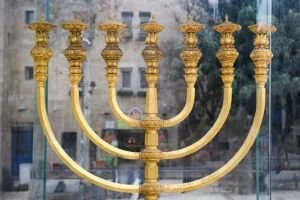
Within the Holy Place of the tabernacle were three pieces of furniture: the Menorah (or lampstand) on the south side, the Table of Shewbread (or Bread of Presence) on the north side, and the Altar of Incense on the west side next to the veil of the tabernacle. The table and altar, made of acacia wood, were overlaid with gold. The menorah was made of one talent (75-100 lbs.) of pure gold and was composed of seven lights (one in the center, and three on either side from branches extending from the central branch). The Table of Shewbread contained twelve loaves of unleavened bread, one for each tribe of Israel. The Altar of Incense represented the prayers of the people. The incense was burned on coals brought in from the bronze altar where the sacrifices were burned.
Past the veil was the Holy of Holies. In this place stood the Ark of the Covenant and the Mercy Seat (or atonement cover). The Ark was made of acacia wood and overlaid with gold. The Mercy Seat was composed of pure gold and sat on top of the Ark of the Covenant. On either end of the Mercy Seat were golden cherubim with outstretched wings spread upward overshadowing the cover. Between these cherubim was where God met with the high priest on each yearly Day of Atonement when the high priest brought blood from the atonement sacrifice and sprinkled it onto the Mercy Seat. Within the ark were kept three things: the ten commandments, a jar of manna, and Aaron’s rod which budded signifying him as God’s chosen for ministering as high priest for the Israeli people.
Each piece of furniture was a representative of a character of Christ. In addition, the position of each piece formed the shape of a cross. The bronze altar represents Christ providing the atonement for our sins (1Jn 2:2), The laver represents the cleansing provided by the Holy Spirit who gives us life (Jn 6:63) and renews us (2Co 5:17) because of Christ’s redemptive work on the cross (Jn 19:30). The menorah represents Christ as the light of the world who gives us enlightenment for how to live for him (Jn 8:12). The Table of Shewbread (Table of Presence) represents Christ as the bread of life, the one who sustains us spiritually (Jn 6:35). The Altar of Incense represents Christ as our intercessor (Hb 7:25) who is now our advocate (1Jn 2:1) before God the Father. The Ark of the Covenant represents Christ who made a blood covenant with us by the shedding of his blood on the cross (Lk 22:20). He is the embodiment and fulfillment of the Law (Mt 5:17), the true manna who sustains us (Jn 6:32-33), and is the proper high priest who intercedes for us (Ro 8:34) and shows his resurrection power which will one day be extended to us who have accepted him as our Savior (Jn 11:25; 1Co 15:20). He is also the Mercy Seat because he made propitiation (atonement for appeasing God’s wrath) for our sins (1Jn 2:2, 4:10).
Understanding all this helps us to better understand the adage that the Old Testament is the New Testament concealed and the New Testament is the Old Testament revealed. The whole Bible is about Jesus Christ and every page reflects him. When some say the Bible is a cohesive whole and not just a collection of stories, this is what they mean. It all points to him because he is the answer for us humans—both in this life and in the life to come. From eternity to eternity, he is always the same (Hb 13:8).
Can I get a hallelujah?!
____________
Visit Books & Words to Inspire by Randy C. Dockens