Books & Words to Inspire

Blog

Understanding Scripture in Light of a Jewish Timeline

Posts tagged Fabrics
Deeper Meaning of the Tabernacle: Fabrics

In the previous post, we talked about the precious metals used in the tabernacle (gold, silver, bronze). This time let’s focus on the fabrics used. The fabrics used were also donated to the tabernacle construction by the Israelites and they were part of the plunder God allowed the Israelites to obtain as they left Egypt. This wasn’t a forced plunder but more of a bribe by the Egyptians to get the Israelites out of their land because of all the plagues and death that had occurred (Ex 12:33-36).

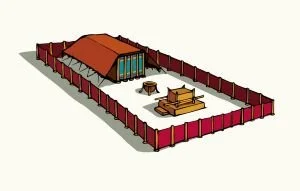
The tabernacle was composed of a courtyard with only one gate to enter and a tabernacle building within it, also with only one entrance. The fabric used for the courtyard fence and the tabernacle coverings were made of fine twined linen. This means this was not ordinary linen but made from fibers that were meticulously twisted together to make the material extremely durable. It would represent the very best type of fabric of their day.

The curtains made from this material for the courtyard fence was white which represented purity and holiness, for the contents of this place was considered holy as this is where God dwelt, or tabernacled, with his people. The courtyard fencing was approximately 150 ft (45 m) long on the north and south sides, and approximately 75 ft (23 m) long on the west and east sides. The curtains were attached to the posts with silver hooks. Each post, 60 total, was atop a bronze base meaning that the tabernacle was based upon judgment. It was a holy place. No one could casually come into this structure.

On the east side, facing sunrise, was the gate to the courtyard. The curtains on this side were composed of blue, purple, scarlet, and white finely twisted linen. These colors represented the heavenly alignment of the tabernacle’s purpose (blue), the divinely appointed aspects of the tabernacle’s contents (purple), the sacrifice/judgment that occurred here (scarlet), and the purity and holiness of the place (white). It is no coincidence that there was only one door. There was only one way to approach God and that was through judgment/sacrifice. Jesus Christ himself reminded his followers of this fact when he stated that he was the door (Jn 10:7-9) and he was the only way to God (Jn 14:6). Almost every aspect of the tabernacle was a foreshadowing of some characteristic of Christ.

The tabernacle itself was composed of four types of coverings. The first covering, visible to only those who entered, was the fine twisted linen which had cherubim embroidered into the fabric as well as the colors blue, purple, and scarlet. Each curtain was made 42 ft (13 m) long and 6 ft (1.8 m) wide. Two sets of five of these curtains were joined together with fifty loops of blue fabric placed on their ends. These two sets were joined together using golden clasps. Over this were placed eleven curtains of goat hair, each slightly larger than the previous curtains. These were 45 ft (13.5 m) long and 6 ft (1.8 m) wide. Again, these were made in two sets: one set of five and one set of six, again with fifty loops on each set but this time were bound together with bronze clasps. The sixth curtain was used as the door of the tabernacle. The additional length of these curtains allowed half of one curtain to form the rear of the tabernacle. This covering provided protection and insulation. Over this covering was placed a covering of ram skins dyed red, and over that a covering of durable leather likely made from a large aquatic mammal (perhaps from porpoise or seal hides as both animals were abundant in the Red Sea).

From the outside, one could only see a drab looking tabernacle, but the inside displayed glorious features but was only seen by the priests who served in the tabernacle. This is reminiscent of how Isaiah portrayed Christ: a man of no special beauty in appearance (Is 53:2), but spiritually he is one of beauty and the one all should seek (Ps 27:4). The goat hair represents that he is our scapegoat and allows us to go free because he is the one sacrificed (Lv 16:7-10) and provides us protection. Thus, the reason for the clasps tying these curtains together being bronze was because bronze represents judgment which was the purpose of the scapegoat symbolizing that Christ would be our sacrifice, our scapegoat, and remove our sins from us (the goat which was set free). The ram skins died red represents his sacrifice for our sins.

There is one other curtain that is important to mention, and that is the veil between the Holy Place of the tabernacle and the Holy of Holies. This curtain was made of blue, purple, and scarlet yarn, and finely twisted linen with cherubim woven into it. It was hung with gold hooks on four posts of acacia wood overlaid with gold and stood on four silver bases. Behind this curtain was the Ark of the Covenant with its Mercy Seat in what was called the Holy of Holies. This curtain separated the area where the priests served within the tabernacle from the area where God himself dwelt within the tabernacle. Only the high priest could go past this curtain and go into this area where God dwelt, and he could only do this once a year to atone for the sins of all Israel.

This curtain represented the way to God and therefore was representative of Jesus Christ as he stated that he was the only way to God (Jn 14:6). A sin sacrifice had to be made before the high priest could go past this curtain. Hence, the reason for the base being silver and not bronze. The high priest could pass once a payment had been made. Jesus Christ’s death on the cross became our payment for our sins.

The whole tabernacle was symbolic of God’s plan to redeem mankind. He did for us what we could not do for ourselves, yet maintaining his holiness and justice. I find it quite remarkable. Don’t you? Join me next time as we look even closer.

____________

Visit Books & Words to Inspire by Randy C. Dockens