Books & Words to Inspire

Blog

Understanding Scripture in Light of a Jewish Timeline

Posts tagged Magi
The Star

“Keeping us waiting here like this for nearly half an hour by this . . . Judean ruler . . . is insulting. After all, we are Magi, members of the royal Magistanes, sent here by king Phraates himself, ruler of all of Parthia, to honor the birth of the newly born King of the Jews.”

“That’s true, Melchior, but that may be what concerns him,” Balthazar says. “He likely thinks he is their king.”

“Yes, yes,” Melchior says, waving his hands. “But surely he’s not so myopic that he doesn’t see the possibility of this one to reunite our people and theirs.”

“Oh, he’s too in bed with Rome to see such a possibility, except as a threat,” Balthazar says. “If we’re interested in him, then he likely thinks we’re here to sabotage his rule.”

“That’s likely true,” Casper says. “Did you see his eyes when he saw king Phraates’ royal guard escorting us in?”

Balthazar laughs. “He tried to hide his reaction, but his surprise was duly noted—especially when he looked from his balcony seeing our contingent of several hundred camels, and equal numbers of servants and guards.”

“Well, what does he expect,” Melchior replies. “We have a large amount of gold, frankincense, and myrrh to protect. Plus, king Phraates doesn’t trust this Herod, especially since he sent the Roman, Mark Antony, to attack him in his own realm of Parthia. It’s clear there is no love lost between them.”

“But our mission is so important,” Melchior says. “Once we show him the star alignments, how can he doubt? There was a triple conjunction of the king planet with the king star in the constellation of the lion. Belteshazzar always taught this constellation represents Judah. Surely this Herod will know that. But in addition, we saw the king planet in conjunction with the mother planet. He can’t consider that a coincidence. And now, we have been following this star which led us here. If the heavens are declaring the birth of a king, surely mere mortals will not ignore it.”

“I hope you’re right,” Balthazar says as he suddenly stands as Herod and his contingent of priests and royal companions enter. Both Melchior and Casper also stand.

“Please, please, be seated,” Herod says. “Apologies for the long wait. I had my priests do some research themselves.”

“We are aware of the prophecy of a coming Messiah,” one of the priests says. “He is prophesied to vanquish all of our enemies and rule from Jerusalem over the entire world.”

Melchior looks at his comrades. Their glance back at him indicates that they, too, believe this statement about enemies include them as well.

“But we know of no one of any prominence to have been born yet. Evidently, this prophecy is still in our future, surely.”

“But what of the star signs?” Melchior replies. “I have the charts right here that your very own prophet Daniel, whom we call Belteshazzar, had Magi in Babylon put together for this very event.”

The priest holds up his hand. “But none of that is in his writings, I’m afraid.”

“Plus,” another religious cleric dressed differently from the other man adds, “prophetic writings are not part of the Torah and cannot be given as much weight as words from HaShem.”

Herod holds up his hands. “But we certainly grant you the benefit of the doubt.” He gives a smile, but it seems somewhat deceptive. “So, in consultation with my advisors here, we also commission you to find this . . . king . . . and give him our homage as well.” He gives another smile, quite evident to be forced. “Send us word and we’ll come and worship him as well.”

All three nod but look wary. “Do you have homage you wish us to take for you to give to him in your honor?” Balthazar asks.

“Nothing now, but we’ll do so when we come. We can’t come ourselves empty handed now, can we?” His words hang in the air, which now seems quite thick with tension.

One of the priests clears his throat. “Our scripture declares that the birthplace of our coming Messiah will be in Bethlehem, just south of Jerusalem. If he has come, which I must warn you is doubtful, he would be there.”

Silence hangs in the air once again. Casper stands. “Thank you for your hospitality. We’ll be on our way and will relay your well wishes once we find this new arrival who can be a unifying force between both our people.”

Herod looks from one to the other. “Unifying . . . force?”

“Well . . . yes,” Casper replies. “As you know most Parthians are originally from this land. This one will be as much a king to us as he will be to you.”

“I . . . see,” Herod replies, though he looks as if he wants to take them as prisoners on the spot, but he smiles instead. “Yes, well, this will be a truly momentous find for sure.”

The three then walk out with their guard escorts as they each feel the eyes of Herod and his entourage burn into them as they exit.

As they mount their camels to leave Jerusalem and head toward Bethlehem, Balthazar looks at Casper. “Was that last part necessary?”

‘No, but it clearly tells us his true intensions.”

Balthasar raises his eyebrows. “He wants nothing to do with this new king. Or with us for that matter.”

“I vote we return home a different way than coming back through Jerusalem,” Melchior replies.

Casper nods. “Oh, most definitely.”

As they approach the small town of Bethlehem, Melchior has only those guarding the gifts come along with them and the larger contingent stay outside the city.

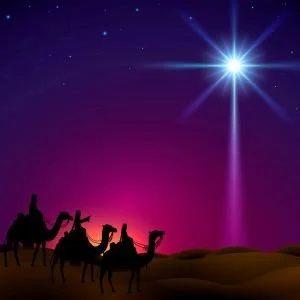
Casper looks up at the star. “Look, the star is practically straight above this town. Our star signs and the Jewish scriptures the priest quoted seem to align.”

Balthazar rubs his chin. “Yes, but even though this town is small, how do we find where this new king will be located? I mean, I don’t think there is anyone of great wealth here. It does seem a little strange a new king would be here, don’t you think?”

Melchior shrugs. “Well, it’s all worked out just as predicted so far. I see no need to doubt now. I say we just enter and see what happens.”

“Well, that doesn’t seem logical,” Balthazar says, “but I have no better alternative.”

The sun is setting as they approach the city, and other stars are now becoming visible. Darkness begins to descend on the city, but not everywhere. They follow a glow and come to a house and stop in front of it.

“This must be the place,” Casper says. “It seems this glow is providential.”

They each descend their camel. The eyes of neighbors look their way but stay in the shadows, afraid to come out. Their guards bring several large chests to the door of the house. One knocks. Once the door opens, the glow around the house dissipates. A man appears in the doorway, eyes wide.

Melchior gives a bow. “We have come a great distance from our home within Parthia to pay homage to the one born here to be king of the Jews.”

The man looks from one to the other, partly in fright, partly in wonderment. “I am Jospeh. My wife, Mary, and I have a son who was born six months ago.

Melchior bows again. “May we have the honor to enter?”

Joseph steps back and lets them and the guards with their chests enter. Mary is sitting with the child in her lap. Her eyes go wide, and she looks at those entering and then to Joseph for an explanation. He gives a slight shrug. “These men have evidently come to pay homage to our son, Yashua.”

The three Magi stand before Mary and genuflect. “It is our honor to meet your son, most blessed among women,” Balthazar says.

“I’m sorry,” Mary says, “but I don’t understand.”

Casper smiles. “We bring gifts from us and from our king Phraates IV, king of Parthia. We bring gold to the one in your lap who is king of the Jews, we bring frankincense as he will function as a type of priest to his people as your scriptures indicate, and we bring myrrh for anointing because your scriptures also indicate he will have to suffer. Three gifts for three important events in your son’s life.

“We have come because your son is a descendant of David, king of Judah, and a descendant of Jehoiachin, made a ruler of Parthia. Your son will one day unite both of our peoples once again as it was in the days of David and Solomon.”

“Our duty as Magi of the Magistanes,” Melchior adds, “is to find those who can become king. Your son, Yashua, meets all the requirements. No decision is needed today, but we wish to follow your son’s path for how he will fulfill his destiny.”

The guards open their chests and Mary gasps. “It’s so much,” she replies. “I . . . I don’t know what to say.” She looks at Joseph with eyes wide.

“It is our honor,” Melchior says. “There is no amount worthy to pay homage to one like your son. Many prophecies will be fulfilled by him. Some physical; many spiritual. God has smiled on both of our peoples this day.”

The three Magi stay for a short while, tell Mary and Joseph all that transpired from the time of Belteshazzar who they knew as Daniel from their scriptures, explaining how he was instrumental in making Jehoiachin a Babylonian satrap, how the Israelites integrated within Parthia but kept many of their roots from their homeland, and how they believe Yashua would be the greatest king the world has ever known.

The three Magi leave, get back on their camels, and travel out of Bethlehem but do not head back through Jerusalem. They know Herod will be angry at them. But that is of no concern to them at this point. They had just met the one who they knew would become someone beyond their wildest dreams. They are unsure of what that would be but are content to have been a part of his journey.

And what about you? Do you have such expectations for your future? Do you also rely upon the one who came as an agent of peace and reconciliation? Have you given your all to him as he has done for you? He came as a prophet to tell and remind us of his promises to us, died to fulfill scripture being the sacrifice for our sins, and has risen to give us hope for the same future in which we can participate. In the end, he promises you a future more glorious than you can ever image.

____________

Visit Books & Words to Inspire by Randy C. Dockens

Gifts of the Magi

You may have heard the story many times about the three wise men who brought gifts to the baby Jesus. We’ve had previous discussions about was it really three, when they came, and how much of an uproar did they really cause when they met Herod. Yet, I want to focus on the gifts they gave. We read the following in Scripture: “And going into the house they saw the child with Mary his mother, and they fell down and worshiped him. Then, opening their treasures, they offered him gifts, gold and frankincense and myrrh” (Mt 2:11).

I’m sure those are not really the gifts you’re hoping for on Christmas morning. Although, gold wouldn’t be so bad, right? But what would you do with frankincense and myrrh? Maybe you’ve heard, “gifts for a king” as the explanation. But why? True, they are all expensive and that is what one would expect someone to give to a king – expensive gifts. Yet, there is more to it than just that. Gold, of course, can, and does, represent his kingly stature. For indeed, he was to become the King of kings (Rv 17:14; 19:16). Frankincense was a spice used in incense and was used in the preparation of the incense used by the priests for worshipping God in the temple (Ex 30:34). Myrrh was a spice used for many things, but also commonly used on the dead for burial (Jn 19:39).

These gifts represented the three stations Christ would fulfill: prophet, priest, and king. Well, this is the order that we normally think, and it is the order in which Christ fulfilled these stations. Yet, this is the reverse order the Magi gave the gifts. Is that significant? I think so. Christ was a prophet at his first coming (Dt 18:15; Mt 13:57, 14:5, 21:11; Lk 1:76, 4:24; Jn 4:19, 6:14, 7:40), and like most prophets, he was killed. Myrrh was used to anoint his dead body for burial. Today, he is our high priest (Hb 4:14-15; 8:1 – 9:28). Therefore, frankincense was a very suitable gift. He is coming back as a king and will reign (Rv 17:14; 19:16). Gold was a very suitable gift to represent this.

Yet, as we stated, the gifts were given in the reverse order of how Christ fulfilled, and will fulfill, them. That is because the gift of king was given first. That is what the angel Gabriel proclaimed to Mary (Lk 1:31-33), that is what John the Baptist proclaimed and offered to the people (Mt 3:1-2), and that is what Christ first offered at the beginning of his ministry (Mt 4:17). Gold – his kingship – was offered first. It was rejected by many people and the leaders of Israel. Therefore, what was offered first became what will be given last. But that did not alter God’s perfect plan because we still benefited as he offered himself as the sacrifice for our sins and now intercedes for us. Yet, this first offer is still offered to us. Yet now, we must first accept the myrrh and frankincense in order to have the gold. Are you willing? Will you accept the myrrh – his sacrifice for your sins? Will you accept the frankincense – have him be your high priest to intercede for you before God the Father? It is only then you can accept the gold – have him as your king and watch him become the King of kings. Christmas is touted to be about peace. That can only happen when you accept the gold, but you must first accept the myrrh. The order of the gifts was important, but the fulfillment of those gifts are even more important. Will you accept them?

____________

Visit Books & Words to Inspire by Randy C. Dockens