As we look at the sacrament of communion, we find that the deeper meaning of this act of communion started way back in the Old Testament—all the way back to Abraham.
When Abraham and his family came into the land of Canaan, his nephew, Lot, and his family settled in the city of Sodom (Gn 14:12). If you recall, Kedolaomer, king of Elam (what is today Iran) had made alliances with several kings within the land of Mesopotamia and attacked several cities around the Dead Sea, including Sodom where Abraham’s nephew, Lot, lived. They took many of those in these cities hostage, including Lot, his family, and his possessions (Gn 14:11-12). A man escaped capture and reported the news to Abraham who went with 318 of his men all the way north to Dan to defeat these armies and bring the hostages and all their possessions back home (Gn 14:14-16). That means he traveled over 150 miles, one way, to retrieve his nephew.
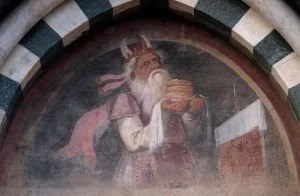
When he returned, Melchizedek came out to meet with him (Gn 14:18). His name means “king of righteousness”, and he is stated to be the king of Salem (which became Jerusalem), meaning “king of peace” who was also high priest of God Most High (Gn 14:18; Hb 7:2). Melchizedek blessed Abraham (who was still named Abram at that time), and they ate bread and drank wine together.
While there are only a few verses in Scripture about Melchizedek, he is a very important figure. He is mentioned in a few verses in Genesis (Gn 14:17-20), in Psalms (Ps 110:4), and in Hebrews (Hb 7). There are many speculations as to who this figure was. One tradition is that he was a descendant of Shem and thus a son of Noah’s line (Genesis 6:10), or perhaps even a first-generation son of Shem himself. If this were the case, it is likely those who knew him, or of him, only knew that (to them) he had “always been” because, for them, life began after the flood. God used this fact to point to the One he would send who would be of this type: one who had always existed and would become a King of Righteousness and King of Peace. Others say Melchizedek was a Christophany and thereby a foreshadow of his future coming. If so, this would be different from other events that are believed to be Christopanies. For example, in other instances, he is usually referred to as “the Angel of the Lord” and the encounter was brief. Here, it seems this individual had a position on the earth for quite some time. I have also heard him referred to as the high priest of Jesus Christ and performed duties in the heavenly tabernacle. If this is the case, then we must address another conundrum: why would one who served in the heavenly tabernacle be on earth for a time? While there is little to support any of these ideas and speculations, what he represents is definitely important and profound. The writer of Hebrews states he is a type of Christ because his priesthood is forever (Ps 110:4; Hb 7:3). Christ has become our high priest and our mediator (Hb 4:14-16) and his priesthood is therefore far superior to the Levitical priesthood that was instituted under Aaron.
What Melchizedek and Abraham participated in was a type of communion that fits both definitions we went over in a previous post. This encounter with Melchizedek reveals there are three things that are a part of such a communion:
1. A High Priest or mediator between us and God is needed.
2. Remembering we live by the Words of God is important.
3. Remembering a covenant with God is essential.
In Abraham’s case, Melchizedek being a High Priest of God, served as mediator. He did not praise Abraham but praised God who saved Abraham from his enemies (Gn 14:20). Abraham’s response was to give him a tithe. God stated that tithing is to teach us to put God first in our lives (Dt 14:23). This is what Abraham did.
The bread was a foreshadowing of Jesus, the Messiah, coming to Earth. The wine a foreshadowing of his blood he would shed to institute a blood covenant with us for all eternity. This was also on the heels of God’s covenant with Abraham in Gn 12.
A second time of such a communion was with Moses, Aaron, his sons, and the 70 elders who went up on Mt. Sinai, met with God (most likely the preincarnate Jesus Christ) where they ate and drank with him (Ex 24:9-11). Again, this was likely bread and wine. The preincarnate Christ was their mediator for God had already said for no one to touch the mountain or they would die (Ex 19:12-13), but here they were on the mountain as the preincarnate Christ had interceded for them to be there. Again, the bread was a foreshadowing of what their coming Messiah would do for them, as well as representing the manna that was soon to come their way to remind them that their very lives were dependent upon God. The manna was also a foreshadowing of Christ coming to be the true bread from heaven giving life to the world (Jn 6:32-35).
And, again, the wine was a foreshadowing of Christ’s blood. They had just had the implementation of the blood covenant he had made with them as a nation. Now, they were participating in a futuristic blood covenant he would make with them as individuals as he would die on the cross for their sin to fulfill all the sacrifices that they would soon implement to also represent the purpose of his coming. The prophet Jeremiah would call this the new covenant (Jr 31:31). Jesus stated that the shedding of his blood is his covenant to us that by believing in him our sins will be forgiven (Mt 26:28).
A third time of such a communion was institution of Passover (Ex 12:1-11). The Israelites were to remember what God had done for them and would continue to do for them as it was also a foreshadowing of their coming Messiah. Over time, the celebration of Passover was codified into a ritual of fifteen steps that all Israelites would follow, called the Haggadah, meaning “telling”:
1. Kadesh – a blessing is given and the first cup of wine, symbolizing sanctification, is drank.
2. Urchatz – a hand washing with water is done to symbolize purification.
3. Karpas – dipping of certain vegetables in salt water is done to symbolize the tears their ancestors shed.
4. Yachatz – the middle matzah of three placed in the center of the table is broken. The smaller half is placed back on the table and the larger is set aside and becomes the afikomen which is hidden for children to find later and eaten as a “dessert” to the seder.
5. Maggid – The second cup of wine is poured, the Exodus story is told, and the wine then drunk to represent their deliverence.
6. Rochtzah – hand as again washed reciting another blessing.
7. Motzi – The leader holds all three matzoth and recites the blessing for bread, places the bottom matzah back on the table and then holds the top and middle, broken, matzoth and recites the blessing for eating matzah. These are then broken in pieces and given to the guests to eat.
8. Matzah – The guests eat their matzah.
9. Maror – Bitter herbs (horseradish or bitter part of romaine) are eaten to reflect the harsh conditions Israelites slaves ensured during Egyptian captivity.
10. Korech – The “Hillel sandwich” is eaten, composed of maror and charoset (paste of apples and nuts) placed between two broken pieces of matzoth from the bottom matzah.
11. Shulcan Orech – The Passover Seder meal is eaten.
12. Tzafun – After the dessert of the seder meal, the afikomen is then eaten as the “dessert” to the seder.
13. Barech – A third cup of wine is poured, a blessing recited, and the wine drank to symbolize their redemption. A fourth cup of wine is poured for Elijah, and the door to the house is opened so the prophet can possibly enter.
14. Hallel – The door is shut, songs of praises are sung, and the fourth cup of wine is drunk to symbolize their hope for being with their Messiah.
15. Nirtzah – The seder is officially over but another blessing is recited: “Next year in Jerusalem” to indicate their hope that all Jews will be able to celebrate Passover in Israel together.
I list these steps because from these steps came the elements of communion that Christ commanded to be kept until his return (1Co 11:26). The middle matzah represented his body. The breaking of the middle matzah (step 4 above) represented his body becoming a sacrifice for us, and the wine of the third cup (step 13 above) represented the shedding his blood for our sins as this was the cup of redemption. It is interesting that he did not drink the wine of the fourth cup, but stated the following: “I tell you, I will not drink from this fruit of the vine from now on until that day when I drink it new with you in my Father’s kingdom” (Mt 26:29). This indicates that this entire Passover was a history lesson from Egypt to Messiah’s first coming and his death, burial, and resurrection, to Messiah’s second coming when we will finally be with him forever. It is truly a meal of communion.
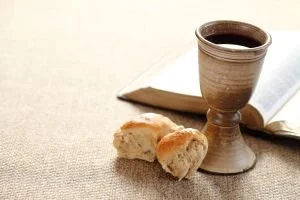
Now, we today, follow in these same footsteps to participate in our blood covenant with Christ. To remember that he came as a sacrifice (represented by the bread) to also shed his blood (represented by the grape juice) for our sins.
You can see that it has always been about relationship with our God, even from the very beginning. This is why Paul stated in 1Co 11:28 for everyone to examine themselves before they eat of the bread and drink from the cup. By this act of eating and drinking, we are fellowshipping with God, the Most High, and with Jesus Christ whose body and blood we are remembering. This is a sacred thing, and we should come in a manner that is appropriate for such an act.
By participating in taking the bread and drinking the wine (or grape juice), we symbolize our recognition of the price he paid for us to be in communion with him and our hope in his return and us being in fellowship with him forever. Isn’t that a beautiful thing?
____________
Visit Books & Words to Inspire by Randy C. Dockens