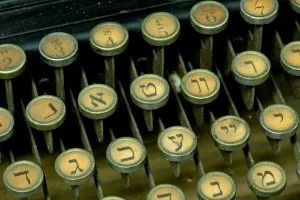
Vintage Hebrew Typewriter
Seeing the Hebrew construct of words can sometimes help us glean a deeper meaning of scripture. Let’s look at several examples of this.
1. The first example in which we will look is this passage in Leviticus 11:39-43 from the NIV. It talks about defilement:
39If an animal that you are allowed to eat dies, anyone who touches its carcass will be unclean till evening. 40Anyone who eats some of its carcass must wash their clothes, and they will be unclean till evening. Anyone who picks up the carcass must wash their clothes, and they will be unclean till evening. 41Every creature that moves along the ground is to be regarded as unclean; it is not to be eaten. 42You are not to eat any creature that moves along the ground, whether it moves on its belly or walks on all fours or on many feet; it is unclean. 43Do not defile yourselves by any of these creatures. Do not make yourselves unclean by means of them or be made unclean by them.
For easier finding, I have placed the word unclean in bold text. Upon reading this passage, it would seem it is about what makes someone unclean and what to do if one becomes unclean. Any reason not to conclude that and just move on? Or is there more to the repetitive nature of this passage? When we come to passages like this and we wonder why it was written so, that is typically a clue that we need to look deeper. That is definitely the case here. The translators from Hebrew to English have translated three different Hebrew words to the English word unclean. Now, we can’t fault the translators too much because each word is talking about being unclean, but just to different degrees. And that matters in our total understanding of this passage.
Verses 39 and 40 have three occurrences of unclean. They each are the Hebrew word tomay (טָמֵא). We can see it contains an aleph and is therefore connected to the God approved way of becoming clean after one is rendered unclean. There is another Hebrew word rendered unclean in verse 41 and the first occurrence in verse 42. This is the word shiqquts (שִׁקּוּץ) which means abominable. Verse 43 (second occurrence) has the word tomathem (טָמֵאִים) for unclean; while one could argue that this is just the plural form of tomay, it does not contain the letter aleph, so it is indicating that this is not God approved and one has actually distanced themselves from God and have become defiled.
So, for the Hebrew reader, this passage has a much more applicable meaning:
39If an animal that you are allowed to eat dies, anyone who touches its carcass will be unclean as God has ordained till evening. 40Anyone who eats some of its carcass must wash their clothes, and they will be unclean as God has ordained till evening. Anyone who picks up the carcass must wash their clothes, and they will be unclean as God has ordained till evening. 41Every creature that moves along the ground is to be regarded as abominable; it is not to be eaten. 42You are not to eat any creature that moves along the ground, whether it moves on its belly or walks on all fours or on many feet; it is abominable. 43Do not defile yourselves by any of these creatures. Do not make yourselves abominable by means of them or be made unclean as God has not ordained (i.e., become defiled) by them.
This presents quite a different perspective, doesn’t it? One act leads to inconvenience, the other appears to lead to something worse as it has a stronger warning attached to it.
2. Another example of subtlety in understanding Scripture comes in the very next verse. In Leviticus 11:44, the NIV reads accordingly:
For I am the LORD (note: all caps means it is referring to Yahweh) your God; consecrate yourselves and be holy, because I am holy. This verse uses the word holy twice, but, again, they are somewhat different in spelling.
The first holy is qadoshem (plural): (קְדֹשִׁ֔ים) because it refers to all the Israelites. The second holy is qadosh (singlular): (קָדוֹשׁ) since it is referring to God. Yet, we see that qadosh has a vav (ו) in it. This is a letter of connectivity – often connecting the heavenly to the earthly. Yet, the vav is not used in the first holy. The ō sound is the dot after the letter dalet (ד) rather than the vav (ו) with a dot above it (both producing the ō sound). This indicates that man can never be as holy as God but should strive in that direction.
3. Let’s look at another example.
In Hebrew, the word truth is emet (אֱמֶת). Again, this word begins with an aleph (א) meaning God is somehow involved (see previous post). If we take the aleph away, we are left with met (מֵת) which means dead. Therefore, from this we see that turning away from God leads to death.
4. And here is another example:
In Genesis 1:1 we have the following:
In the beginning, God created the heavens and the earth: בְּרֵאשִׁית בָּרָא אֱלֹהִים אֵת הַשָּׁמַיִם וְאֵת הָאָרֶץ (Bereshit bara Elohim et hashamayim ve'et ha'aretz).
Bereshit means in the beginning. Bara means created. Elohim means God. Et has no interpretation (it designates the direct object of the sentence). Hashamayim means the heavens. Ve’et means and as the vav is a letter of connectivity with et again designating the second direct object of the sentence. Ha’aretz means the earth.
We stated that et is an indicator of the direct object of a sentence and in this case both heavens and earth are direct objects of created. Yet, rabbis state that because et (אֵת) is the first (aleph) and last (tav) letter of the Hebrew alphabet and comes after bara (created), it means that God created the alphabet before he uttered the words which created. Therefore, they believe Hebrew is the language of God and is the reason it is so powerful and has so much meaning.
This also indicates that God’s words are powerful, and we should pay attention to all he says. John 1:1, 14a says, In the beginning was the Word and the Word was with God and the Word was God. The Word became flesh and made his dwelling among us. John is telling us that Jesus, the Messiah, is the Word of God; therefore, all his words to us are important but we should especially pay attention to his last words on the cross. Join me next time as we do just that.
____________
Visit Books & Words to Inspire by Randy C. Dockens