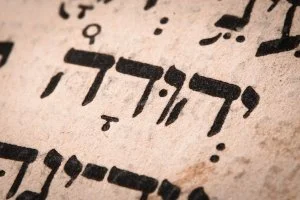
Hebrew Letters
The Hebrew alphabet is composed of 22 letters. Each letter has symbols, names, a numerical value, and a picture that is associated with it that helps to convey meaning. Let’s look at the first letter, aleph (א). It is a consonant. While most consonant letters have a sound that goes with it, aleph does not. It is a vowel placeholder for vowels placed with the word. In addition, each syllable must start with a consonant, even if it has no sound of its own. Aleph fits that requirement. It also helps to distinguish words that are different but sound alike as it would be spelled differently with the inclusion of an aleph. For example: עֵץ (etz) means tree, and אֵץ (etz) means to rush. Their different meaning would be clear from its context within a sentence.
The letter is also associated with the number 1 and so it is often associated with God. It is spelled aleph (א), lamed (ל), pe (פ or ף if at the end of a word) and therefore has a numerical value of 1 for aleph, 30 for lamed, and 80 for pe with a total of 111 and shows the unity in plurality, but also shows the 3 in 1 character of God: the Trinity. This is also shown in scripture as in Deuteronomy 6:4 which says, “Hear O Israel: The LORD our God, the LORD is one.”
Its shape is considered the connection of a slanted vav (ו) between two yud (י) letters. This gives a numerical value of 10 for yud, 6 for vav, and 10 for yud for a total of 26. This is then compared to the tetragrammaton, the unpronounced name of God in Hebrew: (יהוה). Often, the name Adoni (meaning Lord) or HaShem (meaning The Name) is substituted. There is some who say the letters spell Yahweh, while others say it spells Yehovah. The numerical value of the tetragrammaton is also 26: (10 for yud (י), 5 for he (ה), 6 for vav (ו), and 5 for he(ה)). Because the value of the shape of aleph is the same as the tetragrammaton, it again shows its connection to God.
The letter aleph is also associated with many names of God, such as the following: El [God: (אֵל)], Elohim [God (plural): (אֱלֹהִים)], Eloah [singular of Elohim): (אֱלוֹהַּ)], Adoni [Lord: (אֲדֹנִי)], Ehyeh asher Ehyeh [I Am Who I Am or I Exist Who Has Always Existed: (אֶהְיֶה אֲשֶׁר אֶהְיֶה)], Adon Olam [Eternal Lord: (אֲדוֹן עוֹלָם)], Adir [Strong/Mighty: (אַדִּיר)].
Here are the first three verses of Genesis chapter 1:
בְּרֵאשִׁית בָּרָא אֱלֹהִים אֵת הַשָּׁמַיִם וְאֵת הָאָרֶץ
Bereshit bara Elohim et hashamayim ve'et ha'aretz: In the beginning, God created the heavens and the earth.
וְהָאָרֶץ הָיְתָה תֹהוּ וָבֹהוּ וְחֹשֶׁךְ עַל־פְּנֵי תְהוֹם וְרוּחַ אֱלֹהִים מְרַחֶפֶת עַל־פְּנֵי הַמָּיִם
Veha'aretz hayetah tohu vavohu ve'choshech al-penei tehom veruach Elohim merachefet al-penei hamayim: Now the earth was formless and empty, darkness was over the surface of the deep, and the Spirit of God was hovering over the waters.
וַיֹּאמֶר אֱלֹהִים יְהִי אוֹר וַיְהִי אוֹר
Vayomer Elohim yehi or vayehi or: And God said, “Let there be light,” and there was light.
You will notice that the first letter of the first word in verse 1 is beit. Only the left side of the letter is open with the up, down, and right side of the letter being blocked. This seems apropos as it is showing the beginning of time, since Hebrew is read from right to left.
Here are four common names for God: El (אֵל) with a numeric value of 15 from the sum of its letters, the Tetragrammaton (Yahweh: יהוה) with a value of 26 from the sum of its letters, Yah (יָהּ) with a value of 31 from the sum of its letters, and Elohim (אֱלֹהִים) with a value of 86 from the sum of its letters. It is interesting to note that in the passage above we can observe that there is an aleph (א) in each of these numeric positions if we count the letters ordinally. This is noted from the bold aleph letters above.
We can also observe that understanding the make-up of some Hebrew words gives us a deeper meaning to their construction. For example, we can see what makes us human. The Hebrew word for Adam (אָדָם) means man and begins with an aleph. If we separate the word here and place the aleph (א) by itself, it means there is a God or spiritual component to man. The remainder (i.e., dam: דָּם) is the physical component of the word as dam means blood.
We can also observe some interesting things about our genetic make-up as well. The formal Hebrew word for father is av (אָב) and has a numerical value of 3. The formal Hebrew word for mother is em (אֵם) with a numerical value of 41. If we add these together, we get 44 which is the total number of chromosomes in every human cell (22 pairs of chromosomes). Now, if we look at the relational names for father and mother, we get abba (אַבָּא) and Ima (אִמָּא) which adds an aleph to each. The value of aleph is 1, so this adds 2 to the total; an individual has 2 sex chromosomes (relational aspect) and thereby gives a total of 26 chromosomes which we know each cell of our bodies possesses to make a total of 46 chromosomes (23 pairs). Is all this coincidence or is there more to it? I’ll let you decide, but there seems to be too many coincidences for it all to be just that. I believe a touch of the divine has occurred here.
Join me next time as we look at how the Hebrew gives us details that we can overlook if we just look at the English translation of words. I think you’ll be surprised. I hope you join me.
____________
Visit Books & Words to Inspire by Randy C. Dockens