Examples of Inclusion
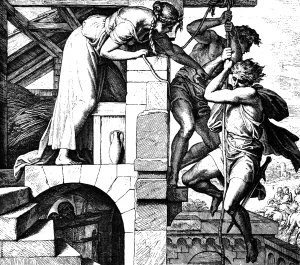
Rahab helping Jewish spies escape.
In our last post, we saw how two separate historical lines began to run parallel to the crimson line weaving its way through history: Israel and the Goiim (the nations). Yet, God was not being exclusionary but was setting up a plan for all. There are several examples of inclusion that we can bring up which brought the Goiim and Israel closer together (Individual Response):
1. Rahab: Even though she lived among a people God had set for annihilation, he saw her heart, her response to him, and spared her life. When Joshua first led the Israelites across the Jordan River into Canaan, the city of Jericho was the first city they attacked. God stated the city was slated for total annihilation: no individual, livestock, or plunder was to be taken – all was to be dedicated to God (Js 6:18-21). Yet, Rahab and her family were saved because of her actions and belief (Js 6:23, 25) and they were incorporated into the nation of Israel. She knew God was above all other gods and would make Israel prosper no matter what (Js 2:10-11). Because of her response to God, he rewarded her faith (Js 6:25). She became the great, great grandmother of King David and the second mother-in-law to Ruth (Mt 1:5-6) as Rahab was the mother of Boaz who married Ruth.
2. Ruth: She grew up and lived in Moab, a country between Edom and the tribe of Reuben on the eastern side of the Jordan River. The people of Moab were descendants of Lot, a nephew of Abraham (Gn 19:30-38). When the Israelites were heading to Canaan, the king of Moab refused to let them pass through their land (Jd 11:17). Later, another king of Moab made Israel subject to him, but Israel later made Moab subject to them through the leadership of the judge Ehud (Jd 3:12-30). Moabites and Israelites became enemies (Jd 3:28). Yet, because of Ruth’s devotion to Naomi, her mother-in-law who had moved to Moab with her family from Israel because of a famine, and her devotion to God (Ru 1:16-17), she, too, was saved and blessed by God (Ru 4:13-22): she became the grandmother to King David (Mt 1:5-6).
3. Asenath: She was the daughter of an Egyptian priest of On (also known as Heliopolis). She was given to Joseph as a wife by Pharaoh himself (Gn 41:45). While scripture is silent as to her conversion, it is likely she did because as the book of Exodus opens, Joseph’s descendant are already incorporated into the lives of the other children of Israel. Although Ephraim and Manasseh were half Egyptian, their descendants were considered Israeli by the rest of the Israelites as well as by future Pharaohs. Both Ephraim and Manasseh became two of the larger tribes within the Northern Kingdom of Israel.
4. Gibeonites: These were Amorite descendants (Hivites) who God had told Joshua to have annihilated (Js 3:10) as the Israelites took possession of the Promised Land of Canaan (Js 9:24). The Gibeonites pretended to be from a far country, wanted to worship the God of Israel, and asked Joshua to make a covenant with them (Js 9:6-15). While the Gibeonites deceived Joshua and the Israelite leaders into making a covenant with them, Joshua still honored the covenant and made them servants to the Levites (Js 9:23). They and their descendants hewed wood and drew water for service of the tabernacle, and later for the temple (Js 9:27). In order to perform duties of worship, they would have had to become proselytes and their males circumcised (Gn 17:11-14; Ex 12:48-49). God also honored this covenant, and King David later had to repay retribution for the Gibeonites who King Saul had put to death (2Sa 21:1). The Gibeonites later became the temple servants (1Ch 9:2) and some even returned to Jerusalem from Babylonian exile with Zerubbabel (Er 2:43) and Ezra (Er 8:20) to continue in this service. They also helped Nehemiah repair the city’s wall (Ne 3:26) and they were incorporated into Jewish society (Ne 11:3). Although those in the beginning may not have been devoted proselytes, God honored future generations that became devoted to Him.
This fits the mandate God had given to Israel to be priests to the Goiim (Ex 19:6). While God had chosen Israel from among the nations (Ex 19:5), they were chosen for a purpose of being an example to these other nations. It was a way to provide inclusion and be brought to God—not as a source of exclusion, although Israel over time mistook God’s words to imply exclusion rather than inclusion. We see that God did not honor them because they were special, he honored them because of his promise, even if they had ignored his mandate (Ml 3:6).
God went from having judges lead the people of Israel to having kings rule over them, per the peoples’ request (1Sa 8:5). The first king was Saul from the tribe of Benjamin which was tied to the birthright clan of Ephraim and contained the Gibeonites who helped the Levites with tabernacle duties. Because of Saul’s pride and disobedience, God rejected Saul and set up David, from Judah, to be king with his offspring to be valid kings of Israel for perpetuity (2Sa 7:12-16). David secured Jerusalem as the capital city which God stated he would place his Name (2Ch 6:6) and secured all the resources for a temple which his son, Solomon, completed (1Ki 6:1; 14).
After Solomon, his son, Rehoboam, caused the kingdom to split with him leading the Southern Kingdom of Judah (two tribes) and Jeroboam leading the Northern Kingdom of Israel (ten tribes). This then created three parallel lines (Goiim, Judah, and Israel) traveling parallel to the crimson line going through history.
Next time, we’ll see what effect this had on God’s plan for the nations. Join me.
____________
Visit Books & Words to Inspire by Randy C. Dockens