Biblical View of the Holy Spirit’s Kingdom
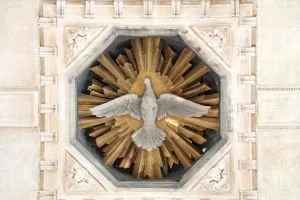
Oratoire du Louvre protestant temple. The Holy Spirit. France.
I will admit that this title you will not find in the Bible, but I’m trying to make a point with how the Trinity will play a role in the kingdom that John the Baptist (Mt 3:2) and Jesus (Mt 4:17) stated “was near.” The Holy Spirit is the Advocate whom Jesus stated would come once he returned to heaven (Jn 14:26, 15:26, 16:7). This came true on the Shavuot (Pentecost) that occurred ten days after Christ’s ascension back into heaven (Ac 2).
Now, of course, the Holy Spirit had been at work for millennia in helping to achieve God’s plan. Yet, he did not indwell individuals continuously before Christ’s ascension back into heaven. This is why David pleaded for God to not withdraw the Holy Spirit from him (Ps 51:11). It can now be considered a kingdom because the Holy Spirit indwells all believers continuously without ever departing from them (Ep 1:13-14). This is most likely the kingdom that John the Baptist and Jesus were referring to when they preached to the people of their day, and the reason Jesus told Pilate that his kingdom was not of this world (Jn 18:36).
Yet, there are two main enemies to this kingdom where the Holy Spirit, being our Advocate, is working in conjunction with Jesus Christ to allow communication to our Heavenly Father: (1) disunity, and (2) normalization of inaccuracies. In a previous post, we mentioned this is what occurred with Israel and made them not ready and not recognizing that Jesus was their promised Messiah from ancient prophecies which they truly believed and taught (see What Went Wrong with God’s Plan). This has occurred with Christ’s Church as well.
Today, it is estimated that there are at least 45,000 different Christian religious denominations over the world. The majority of these stems from a background in Roman Catholicism, Eastern Orthodoxy, Protestantism, Anglicanism, or Pentecostalism. Plus, there are many other smaller independent movements (see How Many Christian Denominations are There?). Some of these differences are cultural as the various cultures of the world adapted how they would worship and celebrate the gospel message into their diverse backgrounds, while others differ from each other with their governance structure: either hierarchical or more autonomous. Then there are theological differences where some depend more on traditions and sacraments while others depend more solely on Scripture interpretation and application. Most of these cannot get along even though Paul taught that unity among believers was vitally important so that a unified and pure bride could be presented to Jesus Christ upon his return (Ep 4:11-13, 5:27). When generations grow up within a disunified environment, it is easy to not realize that this is not pleasing to the Lord. Nothing is done to rectify the situation because it seems to be the norm of the day and not something recognized that needs rectification.
There is no specific reason that denominational differences must impeded unity between believers if they believe that Jesus Christ is the way, the truth, and the life in how one becomes and lives as a Christian. Yet, Scripture interpretation around what constitutes salvation, what is considered a religious liberty, and what is allowed within a worship service have kept most denominations apart from each other whether this is due to rituals making others feel uncomfortable in that worship environment, not agreeing on the basics of salvation, or what is considered allowed for how Christians should act or interact with other believers and/or nonbelievers. The apostle Paul preached to many people with different cultural and ethnic differences and still felt that unity across believers was important: Make every effort to keep the unity of the Spirit through the bond of peace. There is one body and one Spirit, just as you were called to one hope when you were called; one Lord, one faith, one baptism; one God and Father of all, who is over all and through all and in all (Ep 4:3-6). The Holy Spirit has always been a unifier and not one who divides.
We can rest assured that God’s plan will not, and cannot, be thwarted. We can become part of his plan, or we can be bystanders and watch at a distance as his plan unfolds. God has always had seasons of the outpouring of his Spirit. He did this at various times to achieve his purpose: with Israeli leaders (Nu 11:25-26), with King Saul and many prophets (1Sa 10:10), when he was forming the Church (Ac 2), and at various times on his Church to elicit revival among the people. This was just a foreshadow of what will be occurring, likely very soon. We’ll discuss this aspect next time. I hope you join me.
____________
Visit Books & Words to Inspire by Randy C. Dockens