How did Jesus Fulfill the Law?
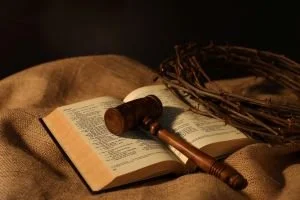
Judge's gavel, Bible and crown of thorns on burlap fabric
Jesus said a couple of things about himself in reference to the Law of Moses:
“Do not think that I have come to abolish the Law or the Prophets: I have not come to abolish them but to fulfill them. For truly I tell you, until heaven and earth disappear, not the smallest letter, not the least stroke of a pen, will by any mean disappear from the Law until everything is accomplished” (Mt 5:17-18).
This is quite the statement. The Greek word translated “fulfill” is πληρόω (pléroó) meaning to accomplish one’s purpose. Jesus showed that the intent of the Law was to show God’s righteousness and not how man could fulfill it with his own efforts. Jesus’ teachings, actions, and atoning death brought the Law to its intended goal. There are four components to the Law that Jesus accomplished: moral (by revealing their deeper spiritual intent), ceremonial (by his death fulfilling the ceremonial and sacrificial system which the Law pointed toward), prophetic (by fulfilling the Old Testament typologies and prophecies about his coming and what his life, death, and resurrection would accomplish), and spiritual (by bringing the Law to its intended purpose of true righteousness that could only be accomplished through him).
Maimonides (Moses ben Maimon, a prominent Jewish scholar during the Middle Ages) stated there are 613 laws within the Law of Moses. Also, there are many, many prophecies about a coming Messiah within the Prophets. In the Old Testament, there are what are called four major prophets (i.e., Isaiah, Jeremiah, Ezekiel, and Daniel) and twelve minor prophets (i.e., Hosea, Joel, Amos, Obadiah, Jonah, Micah, Nahum, Zephaniah, Zechariah, and Malachi), and almost all of them have something to say about their coming Messiah. As an aside, these are called “major” and “minor” because of their length and not for their importance.
According to Maimonides, the Law of Moses contains both positive commands (248 of them) and negative commands (365 of them). These commands contain those about religious observances, ethical behavior, and civil justice. Most of the religious observances were about the sacrificial system and what to do with each type of sacrifice and how to maintain purity laws as they went about making the required sacrifices. Since all the sacrifices, as well as all aspect of the tabernacle (or temple) itself reflected the coming Messiah and what he would accomplish, his death satisfied and fulfilled their actual intent and prophetic nature. Since Jesus was without sin (1Pt 2:2; 1Jn 3:5), he definitely fulfilled all the ethical behavior aspect of the Law of Moses. He even fulfilled the aspects of civil justice as his miracles, signs, and wonders showed that all their sickness, diseases, and the laws that regulated how they would handle them were fulfilled in him because he had authority over all of them (e.g., Mt 8:1-17) and could cure them. And since he had the power to forgive sins (Mk 2:5-12; Lk 7:36-50), he was able to fulfill the justice aspects of the Law as well.
One important reason that Jesus came to fulfill the Law was so he could initiate a New Covenant with us. This was prophesied by Old Testament prophets (Jr 31:31-34; Ek 36:26-27) and announced by Jesus just prior to his crucifixion (Lk 22:20). His death and blood fulfilled once and for all what all the animal sacrifices over the centuries could not do (Hb 10:1-18). Jesus Christ became the culmination of all that the Law of Moses was set up to point toward, and we are now the beneficiaries of this. We can now approach God through prayer without having to go through a priest (Hb 4:16), we can pray directly to him (Mt 6:9), and our way to the Father is through Jesus Christ and what he did on the cross (Jn 14:6).
As stated previously, Jesus, as the Messiah, was prophesied to have three roles: prophet, priest, and king. He did not fulfill all the prophecies for each of these roles during his first coming, but is still fulfilling some of them, and will fulfill more of them in our future (see The Three Roles of the Messiah). Yet, he is most assuredly the fulfillment of all that the Law, the Prophets, and the Psalms said about him (Lk 24:44). This means we can have absolute confidence in him, what he has done, and all that he will do. Praise God for a God like that. Amen!
____________
Visit Books & Words to Inspire by Randy C. Dockens