What is Christian Science Fiction?
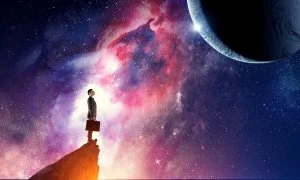
Christian Science Fiction Explores the Reality of the Unexplained
You may have seen a book listed in a genre called Christian Science Fiction and wondered what that classification even means? Is that you? Then this post is for you.
Sometimes you may also see this genre listed as Christian Speculative Fiction or just Speculative Fiction. Yet, that doesn’t really define it any better, does it? Let’s try and demystify this genre. First, let’s break this genre down into its subparts.
Fiction, in literature, is prose that describes something or someone that is not real from a historical, scientific, or literal definition. While this is the case, the comprised story around such a figure or thing must feel real and be able to be believable. Although not part of actual reality, it must feel that it is somehow connected to reality.
The term science defines something that is based on fact or something that is observable, known, real, or at least discoverable—even if that is of a theoretical nature. For example, it has been discovered that protons and neutrons, elements of an atom, are composed of quarks and are held together by gluons. These particles were theoretical until gluons were finally detected by scientists in the late 1970s. However, quarks, so far, have remained elusive in isolating and detecting them, mainly due to the unique characteristics of how they function. Yet, scientists don’t doubt that quarks exist. They would still lay in the classification of science and not relegated to fiction.
Now, when these two terms are placed together (science fiction), It relays the idea that there is something science-related that is not true or real but will feel real within the confines of the story that is being presented. This could be many different things: time travel, parallel universes, disintegrating laser rays, teleportation, etc. In other words, things or events that cannot be part of our known world (or at least not yet). What the writer of the story does, however, is make it seem real, seem believable, and give logic and boundaries around the subject to make it feel true.
Granted, science fiction as a genre has been around a long time and has even led to discoveries that have made science fiction in the past be part of mainstream in the present. For example, remember how the Jetsons had video teleconferences. At the time the show first appeared, that was something fanciful, just wishful thinking. Today, no one gives the idea a second thought. It is something that happens every day in practically every country, and every business, around the world. Do you even think twice about using FaceTime to not only talk to, but see your loved one in real time?
Science fiction has developed a dedicated following and can be from the theory of advanced technology, advanced civilizations, or even lifeforms from other worlds that may or may not look humanoid. This gives a writer a plethora of topics and storylines from which to choose and expand upon. The only caveat, as stated above, is that the speculative part of the story must feel real and be believable to the reader. The reader doesn’t have to understand the technology, but the writer must present just enough science, typically in generalities, so that the reader is made to feel that such a technology or event can be true. The writer craftily intersects reality with imagination.
So, what is Christian science fiction? It is adding another layer to science fiction. It is saying that all the imagination that goes into a science fiction story has an architect that controls all the unreal elements of the story, and that architect is God. In the strictest sense, it means that the storyline has a biblical connection. This could be superficial in nature, or the story could yield deep biblical meaning to the storyline. One may ask: if the Bible deals with reality, how does science fiction which deals in non-realities coexist? A simple answer would be that God is in control of, and understands, all things—even things we are not yet aware of. So, what is considered science fiction to us would not be science fiction to him. He already knows of its existence even though we have not yet discovered the thing, event, or technique.
In Christian science fiction, some attribute or character of God is portrayed or hinted about in the story line that the author is presenting. For example, in my series The Coded Message Trilogy, the idea is that God can penetrate a godless society and reveal himself if the person or persons seeking truth is honestly seeking an understanding about it. In Erabon Prophecy Trilogy, the idea is that God is God everywhere, meaning that if aliens were to exist, then the God that we know would be the same God they would know because the God of the Bible is the God of the entire universe.
To present such topics, they must originate from a biblical worldview. This is the topic of my nonfiction book, Why is a Gentile World Tied to a Jewish Timeline? The Question Everyone Should Ask. In this book, I present how the Bible is not just a collection of stories, but a cohesive, comprehensive, presentation of God’s plan for the entire world. There is a connection between all humans and himself, and this book presents that connection, provides the meaning to all our questions, and gives assurance to an outcome for humanity that he has designed that cannot be thwarted, even when things seem dark and is not going our way. Each series that I have written hinges on the information presented in this particular book.

How We are All Connected
Therefore, truth, or truth concepts, can be presented in fiction stories as easily as they can be presented in nonfiction presentations. It is a way to perhaps make truth more palatable to the reader who might not otherwise read a nonfiction book about the same topic. It may not lend itself to providing detailed answers to the question or topic raised but will give readers information to ponder and perhaps then read a nonfiction book about that topic which can go into more detail and provide greater understanding. The fiction provides the curiosity of the topic. The nonfiction then provides the answers to the questions that the fiction story introduces.
____________
Visit Books & Words to Inspire by Randy C. Dockens