Erabon and the Prophecy
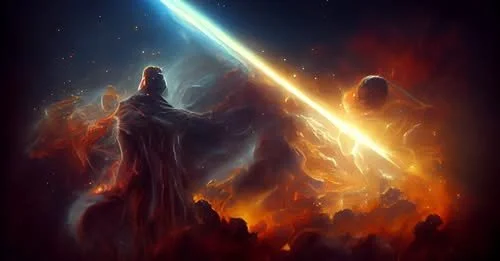
Who Is Erabon?
In the Erabon Prophecy Trilogy, Erabon is the central deity of a system comprising six alien planets. While he does not appear as a physical character in the initial books, his return is the focal point of the series’ spiritual and political arc.
Role and Identity
A Missing Creator: Erabon is the deity who long ago departed the six worlds, leaving behind a prophecy regarding his eventual return.
The Object of Prophecy: The entire trilogy revolves around preparing the various alien cultures for Erabon’s return. This return is contingent upon the unification of the warring clans across the planets.
Messianic Parallel: In the context of Christian science fiction, Erabon serves as a messianic figure. The protagonist, Nuke, acts as his prophetic forerunner, a role intended to prepare the way for the deity’s arrival.
Etymology and Symbolism
Biblical Meaning: The name “Erabon” is likely derived from the Hebrew word ‘ērābōn (עֵרָבוֹן), which means a “pledge” or “earnest.”
Spiritual Significance: In biblical terms, this refers to a down payment or a guarantee of a future transaction. This fits the series’ theme, as the prophecy itself is a pledge that the deity will one day return to his people.
Erabon and the Six Planets
In the Erabon Prophecy Trilogy, the six planets are neighboring worlds in a distant solar system that the protagonist, Nuke, must travel between to fulfill the ancient prophecy.
The Six Planets of the Erabon System
Here are the six planets of the Erabon system:
Myeem: The first planet Nuke arrives on after his accident near Neptune. It is inhabited by citizens who look vastly different from humans.
Eremia: The second planet Nuke visits. He initially finds it difficult to fit into the culture here, just as he did on Myeem.
Sharab: Featured in the second book, Nuke works with leaders here to resolve cultural differences and prevent a civil war.
Ramah: Also featured in the second book, its culture is deeply intertwined and codependent with that of Sharab.
Qerach: One of the final two worlds Nuke must unite. The inhabitants here look more humanoid and similar to Nuke, yet they are resistant to his mission.
Aphiah: The other final world in the system. Like Qerach, its people bear a closer resemblance to humans but remain difficult to convince of the prophecy’s importance.
The Symbolic Connection
In the Erabon Prophecy Trilogy, the relationship between the six planets and Erabon is a science-fiction allegory for the unity of the church and the restoration of creation.
The symbolic connection is defined by three main concepts:
1. The Pledge of Restoration
The name Erabon is a transliteration of the Hebrew word for “earnest money” or “pledge” (erabon). Symbolically, the existence of these six planets and their unique cultures serves as the “down payment” on a divine promise. The planets are not just rocks in space; they are the physical evidence of a covenant that Erabon will return to claim what is his.
2. The Body of Many Parts
Each planet represents a different clan or culture with distinct appearances and traits—some vastly alien like those on Myeem and others humanoid like those on Qerach.
The Symbolism: This mirrors the Christian doctrine of the Body of Christ, where many diverse parts must function as one whole.
The Conflict: Erabon’s return is gated by their unity. As long as planets like Sharab and Ramah remain in conflict, the pledge cannot be fulfilled. Their cooperation is the spiritual key that unlocks the deity’s return.
3. The Interstellar Gates as Faith
The technology connecting the planets, the interstellar gates, symbolizes the spiritual infrastructure required for this unity.
The Connection: Nuke, the outsider hero, must use his scientific knowledge to keep these gates functioning.
The Meaning: This suggests that science and technology are the tools Erabon provided to help his people overcome their physical isolation and achieve the spiritual unity required for his return.
4. The Mirror of Earth
Nuke finds customs on these planets that “eerily parallel” his own heritage. Symbolically, this implies that the Erabon Prophecy is not just an alien story, but a universal one. The relationship between the planets and Erabon reflects the relationship between Earth and God, suggesting that the prophecy is a cosmic version of the biblical Great Commission.
The Return of Erabon: The Condition for Survival
The return of Erabon serves as the ultimate Judgment Day. Will the system face salvation or destruction? Erabon’s return is contingent on the behavior of the inhabitants—that is, Erabon will only return once the six warring clans across the neighboring planets are reunited. In the final book, Qerach, the return is presented as a binary outcome: Nuke’s success leads to ultimate salvation while failure to unite the planets leads to the ultimate destruction of their civilizations.
Conclusion In the Erabon Prophecy Trilogy, Erabon’s centrality to the series is primarily because his promised return provides the primary motivation for the entire plot, the structure for the world building, and the core spiritual allegory of the series.